• Latest
  • Trending
Dynamic Fees in AMMs: When the Signal Matters

Dynamic Fees in AMMs: When the Signal Matters

July 29, 2026
What Happens When Two Miners Find a Block at the Same Second? Inside an Orphan Race

What Happens When Two Miners Find a Block at the Same Second? Inside an Orphan Race

July 29, 2026
Trade.xyz to Reimburse SK Hynix Perp Traders After Price Anomaly

Trade.xyz to Reimburse SK Hynix Perp Traders After Price Anomaly

July 29, 2026
Next XRP Move May Break $1 Threshold, Ethereum (ETH) Already Eyes $2,000, Near Protocol (NEAR) Is Out of Trend: Crypto Market Review

Next XRP Move May Break $1 Threshold, Ethereum (ETH) Already Eyes $2,000, Near Protocol (NEAR) Is Out of Trend: Crypto Market Review

July 28, 2026
Google AI Overviews: What Businesses Need to Know in 2026

Google AI Overviews: What Businesses Need to Know in 2026

July 28, 2026
PYUSD deposits and withdrawals now available on Stellar!

PYUSD deposits and withdrawals now available on Stellar!

July 28, 2026
Coinbase wants to be Canada’s ‘everything exchange,’ but says clearer rules are needed first

Coinbase wants to be Canada’s ‘everything exchange,’ but says clearer rules are needed first

July 28, 2026
Today’s Top Stories: Alphabet and Tesla Earnings, Oil Prices and AT&T Buyback in Focus

Today’s Top Stories: Nvidia, Coca-Cola, PayPal and Falling Oil Prices

July 28, 2026
Robinhood Targets $100B Startup Boom With New Ventures Fund II for Y Combinator Access

Robinhood Targets $100B Startup Boom With New Ventures Fund II for Y Combinator Access

July 28, 2026
The Stablecoin Control Plane: What Visa’s Open USD Move Really Signals

The Stablecoin Control Plane: What Visa’s Open USD Move Really Signals

July 28, 2026
  • Privacy Policy
Wednesday, July 29, 2026
MtRushmoreCrypto - Where Crypto Rocks
  • Home
  • Top News
  • Crypto
  • Crypto Technical Analysis
  • About Us
No Result
View All Result
  • Home
  • Top News
  • Crypto
  • Crypto Technical Analysis
  • About Us
No Result
View All Result
Logo
No Result
View All Result
Home Crypto Technical Analysis

Dynamic Fees in AMMs: When the Signal Matters

J_News by J_News
July 29, 2026
in Crypto Technical Analysis, Top News
0
Dynamic Fees in AMMs: When the Signal Matters
0
SHARES
0
VIEWS
Share on FacebookShare on Twitter


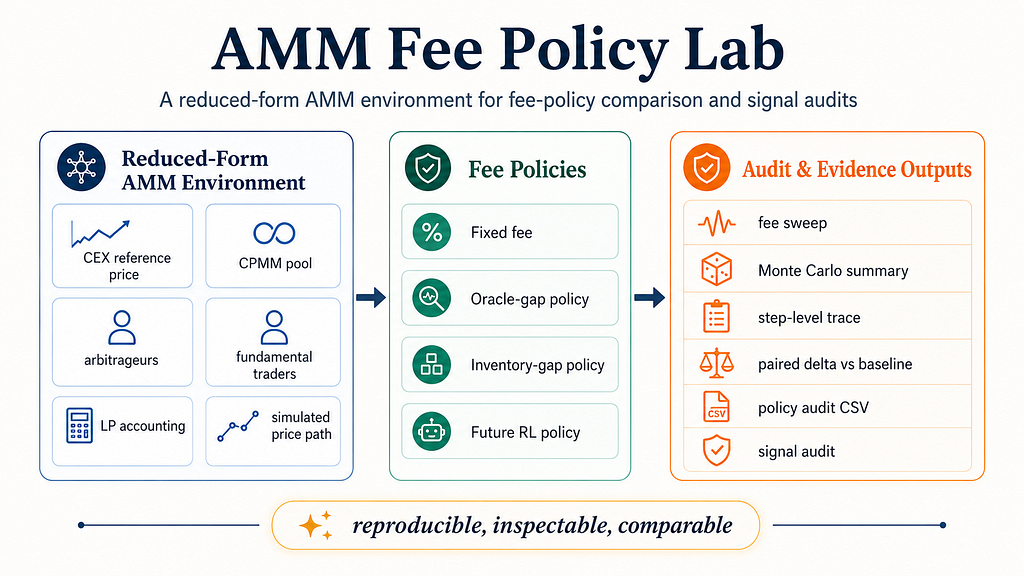
Part I asked whether an AMM surface formed. Part II ran pool state forward. Part III contrasted reserves with book depth. This piece runs the AMM defense layer: fixed fee vs state-responsive fee.

Overview. Campbell-style CPMM simulation with interchangeable fee policies. Illustrative parameters; not calibrated to a live pool.

Part III ended on dynamic fees as evidence that the fixed-fee pool was under-defended-not as proof that hooks beat a book. Uniswap v4 dynamic fees make the defense layer callable: a hook can read pool state and set the fee per swap.

Related articles

What Happens When Two Miners Find a Block at the Same Second? Inside an Orphan Race

What Happens When Two Miners Find a Block at the Same Second? Inside an Orphan Race

July 29, 2026
Trade.xyz to Reimburse SK Hynix Perp Traders After Price Anomaly

Trade.xyz to Reimburse SK Hynix Perp Traders After Price Anomaly

July 29, 2026

The design question is narrower than “can the hook observe more fields?” Under this constant-function market maker (CFMM) setup — specifically a constant-product market maker (CPMM) — does an extra field add information, or only rescale a response the invariant already implies?

I put Campbell et al. (2025) and Baggiani et al. (2025) into the same Rust lab. Campbell et al. supply the fixed-fee LP objective and the routing mechanism: when CEX trading is costly, a stale AMM can still attract fundamental flow by charging a low enough fee. Baggiani et al. supply the policy question — whether observation-based fees can beat a static optimum. Four policies share one FeePolicy interface and the same Monte Carlo paths: fixed 6 bps, fixed 10 bps, oracle-gap, and inventory-gap.

The bridge is market-making control. Campbell et al. define what the pool is trying to protect: fee revenue net of stale-price loss. Baggiani et al. change the fee from a scalar parameter into a policy over market state. A CLOB maker does this through spreads, size, cancels, and exposure limits when flow turns toxic. A programmable AMM cannot reproduce the whole book, but fee is its smallest spread-like defense.

The Campbell baseline

This is a baseline check, not a fee-design breakthrough. A CEX or oracle reference moves before the pool price does. Arbitrage closes the gap; the LP absorbs LVR. Campbell et al. formalize that setting with arbitrageurs, fundamental traders, and a passive LP. Hedged PnL is fee revenue minus tracking error.

In the lab, oracle_gap_bps is pool price vs CEX price in bps-the exposure window before arb trades. arb_delta closes the gap each step; hedged_pnl records what the LP kept net of LVR.

With a 10 bps CEX fee, the optimum AMM fee lands near 6 bps. Higher fees extract more per arb trade but widen the no-trade band and lose fundamental flow. I reproduced the sweep in Rust-1 to 100 bps on one GBM path, then 500-path Monte Carlo.
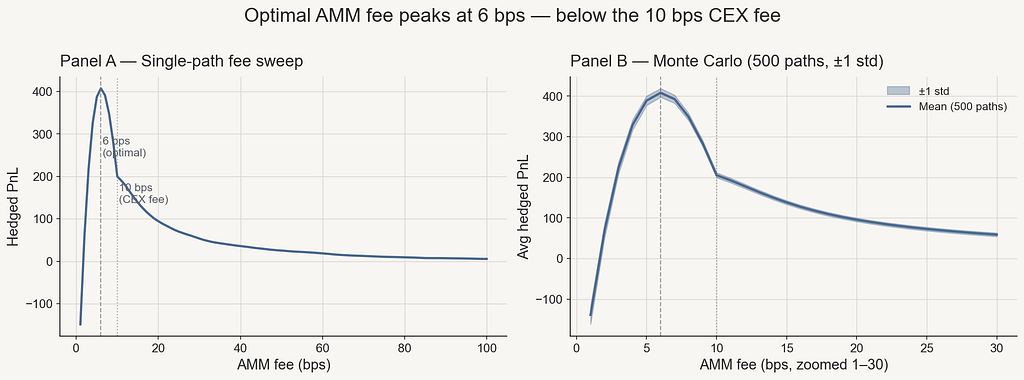
Panel A: hedged PnL vs AMM fee on a single GBM path. Panel B: Monte Carlo mean with shaded ±1 std band, zoomed to 1–30 bps.
Fig. 1. The fixed-fee optimum stays near 6 bps under this setup. Going below it leaves LVR uncovered; going above it prices out flow. Panel A: one GBM path. Panel B: 500-path mean (±1 std, 1–30 bps). Source: amm-lab.

Below 6 bps, arb keeps trading but the fee does not cover LVR. Above 6 bps, the pool keeps some arb revenue but loses fundamental flow to the CEX.

Fee as a policy

Dynamic fees are control laws over observations. Production hooks override the fee in beforeSwap or via updateDynamicLPFee. The simulation uses the same surface: observe state, choose fee, run arb and fundamental trades.

FeeObservation carries oracle gap (bps), inventory skew, and recent realized volatility. In this comparison, realized volatility is recorded but not used in the fee rule. Each step calls policy.fee(&obs) before trades execute.

FixedFeePolicy reproduces the Campbell baseline. In these runs, fee is stored as a fraction ( 1 bps = 0.0001, so base_fee = 0.0006). The two dynamic policies are:

  • OracleGapFeePolicy: fee = base_fee + 0.04 × |oracle_gap_bps| / 10 000, clamped to [1, 20] bps
  • InventoryGapFeePolicy: fee = base_fee + 0.01 × |inventory_skew|, clamped to [1, 20] bps

Oracle-gap charges more when the pool has drifted from the CEX. Inventory-gap charges more when reserve composition is imbalanced. Same interface; different stated signal.

Oracle-gap beats fixed 6 bps on every path

Across 500 paired Monte Carlo paths, oracle-gap beat fixed 6 bps on every path: mean Δ hedged PnL +15.2, minimum +8.
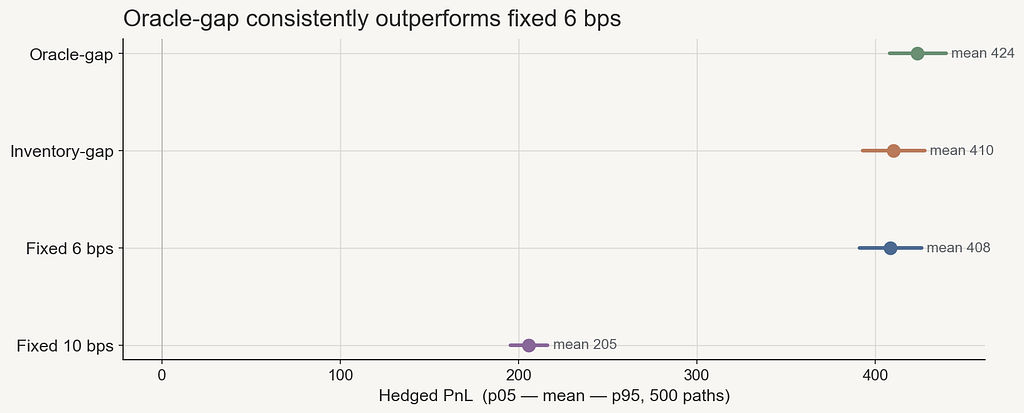
Dot-interval chart showing hedged PnL p05–mean–p95 for four policies across 500 paths.
Fig. 2. Fixed 10 bps underperforms for the same reason as Fig. 1: it overcharges and loses flow. Both dynamic policies beat fixed 6 bps, but only oracle-gap delivers material lift (p05–mean–p95, 500 paths).

The comparison is paired by seed: fixed, oracle-gap, and inventory-gap run on the same GBM path and demand draws. The delta distribution is the useful statistic because it asks what changed when only the fee rule changed.
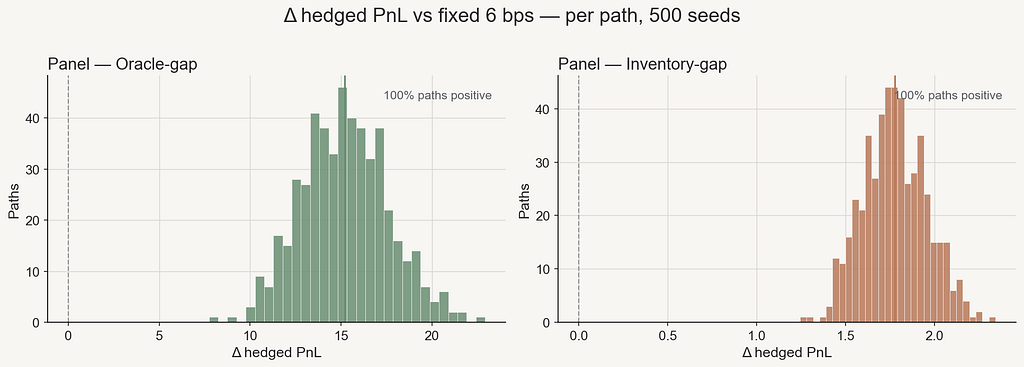
Fig. 3. Same sign, different magnitude: oracle-gap adds +8 to +22 per path; inventory-gap adds +0.5 to +2.5 (500 seeds). The policy ranking is not close.

Inventory-gap also beat fixed 6 bps on every path, but mean gain was only +1.8 -roughly one-eighth of oracle-gap’s advantage.

Inventory skew collapses into oracle gap

Inventory skew is not a new signal here. In a CPMM, both fields are monotone functions of the same quantity-deviation between AMM and CEX price:

oracle_gap_bps  = (P_amm − P_cex) / P_cex × 10 000
inventory_skew = (P_amm − P_cex) / (P_amm + P_cex)

When arb keeps the pool near the CEX price, P_amm ≈ P_cex and the skew denominator is approximately 2 × P_cex:

inventory_skew ≈ oracle_gap_bps / 20 000
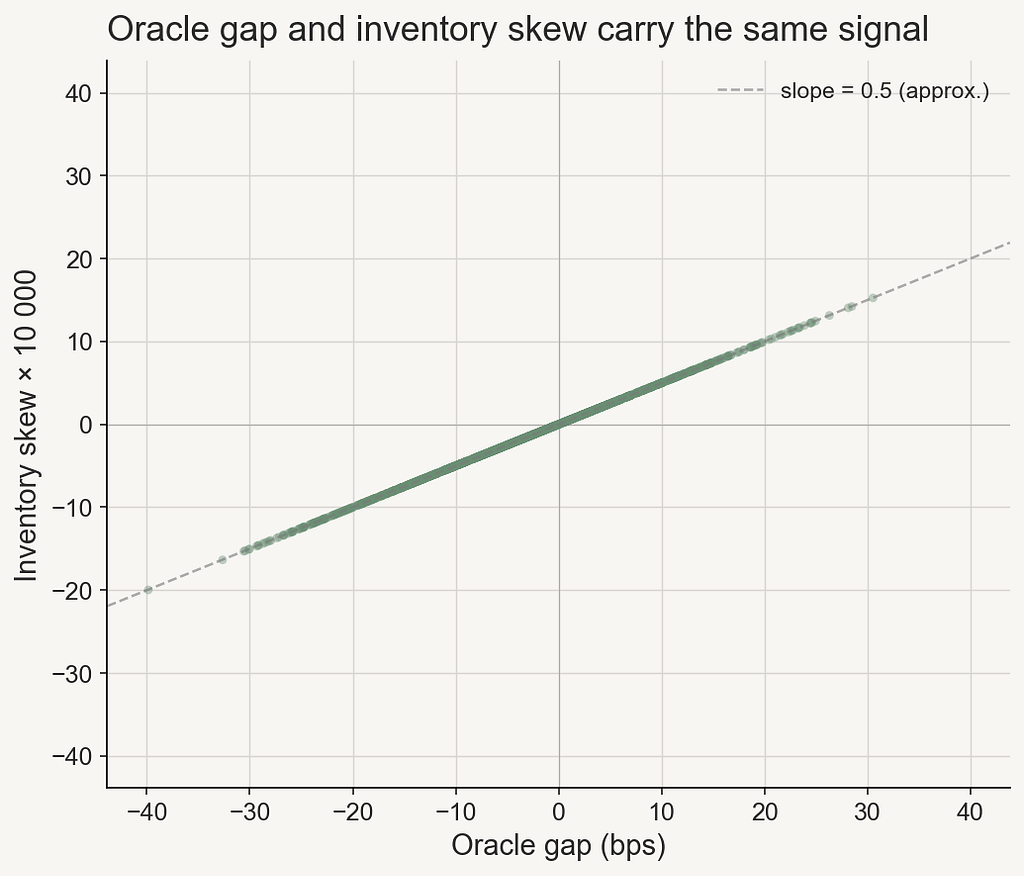
Scatter plot of oracle gap (bps) vs inventory skew × 10 000, showing near-perfect linear relationship.
Fig. 4. These variables are effectively the same coordinate in this model. Near-linear fit (slope ≈ 0.5, Pearson r = 1.000 to four decimals) shows inventory-skew policy is mostly oracle-gap policy with lower gain.

InventoryGapFeePolicy applies the same signal at lower gain—the step-level audit in the repo shows why. The +1.8 mean gain is amplitude, not a different signal.

This is specific to constant-product pools where arb continuously aligns pool price with the external reference. In pegged-pool designs, reserve imbalance can move while marginal price stays near peg, so inventory can carry information not captured by current oracle gap. Curve’s offpeg_fee_multiplier is aimed at that regime, not at CPMM-style rescaling.

What a hook should test next

If the feature is reserve-derived in CPMM, assume redundancy until shown otherwise. Current oracle gap is the primitive; inventory skew, reserve ratio, and pool price are functions of it. Adding them does not expand the information set. It rescales the response.

The next candidate is not another reserve-derived field. It is path-derived or external:

  • Realized volatility: not recoverable from instantaneous CPMM state
  • Order-flow imbalance: directional pressure within a block, visible before the swap executes
  • Oracle latency: time since last reliable external update
  • Toxic-flow proxy: share of recent volume from arb vs fundamental demand

These break collinearity because the invariant does not encode them. The test: does the feature add information beyond current oracle gap under the same path and demand assumptions?

Closing

Part II ran two settings: a seeded path where fees beat LVR, and a deterministic shock where LP-vs-hold stayed negative. The policy layer matters here: oracle-gap dynamic fees beat fixed 6 bps on every sampled path, while inventory-gap adds only a small lift because the two signals are nearly collinear.

That does not prove dynamic fees rescue LP economics in production. The run uses illustrative parameters (σ = 4%, μ = 0, 100 Y fundamental demand per step, CEX fee = 10 bps). The gain still depends on multiplier, demand, and volatility regime, even if the signal relationship is structurally redundant under the CPMM invariant.

Production should be stricter than simulation. This reduced-form world has no gas auction, block latency, queue dynamics, or LP repositioning cost. A hook that freely explores fee settings with LP capital can become statistical gambling once those frictions enter. The safer version starts from a champion rule, deviates only when edge clears cost and uncertainty, and can abstain.

Under CPMM, most fee innovation is control law, not information. The next test is strict: add a path-derived feature (realized volatility or order-flow proxy), check orthogonality to oracle gap on the same paths, then keep it only if paired PnL improves at matched risk.

Appendix: source

  • Part I: The token appeared twice. The AMM market formed once.
  • Part II: Before MEV, I Built a Rust AMM Lab to Measure Pool State.
  • Part III: Hyperliquid Shows What a Market Looks Like Without an AMM Pool.
  • Github Repo: amm-lab, Campbell simulation and dynamic-fee policy runs
  • Campbell: Campbell, S., Bergault, P., Milionis, J., and Nutz, M. (2025). arXiv:2508.08152.
  • Baggiani: Baggiani, L., Herdegen, M., and Sánchez-Betancourt, L. (2025). arXiv:2506.02869.

This post was originally published on my personal blog: https://egpivo.github.io/2026/07/21/dynamic-fees-amm-signal-matters.html


Dynamic Fees in AMMs: When the Signal Matters was originally published in The Capital on Medium, where people are continuing the conversation by highlighting and responding to this story.


Source link

ShareTweetShareShare

Related Posts

What Happens When Two Miners Find a Block at the Same Second? Inside an Orphan Race

What Happens When Two Miners Find a Block at the Same Second? Inside an Orphan Race

by J_News
July 29, 2026
0

Key TakeawaysAntpool and Foundry USA both mined block 941,881 within 12 seconds of each other on March 24, 2026.Foundry won...

Trade.xyz to Reimburse SK Hynix Perp Traders After Price Anomaly

Trade.xyz to Reimburse SK Hynix Perp Traders After Price Anomaly

by J_News
July 29, 2026
0

Trade.xyz, an operator of onchain perpetual markets on Hyperliquid, said it will cover eligible liquidation losses after a price anomaly...

Next XRP Move May Break $1 Threshold, Ethereum (ETH) Already Eyes $2,000, Near Protocol (NEAR) Is Out of Trend: Crypto Market Review

Next XRP Move May Break $1 Threshold, Ethereum (ETH) Already Eyes $2,000, Near Protocol (NEAR) Is Out of Trend: Crypto Market Review

by J_News
July 28, 2026
0

Once again, XRP is getting close to one of its most crucial levels of psychological support. The asset broke out...

Google AI Overviews: What Businesses Need to Know in 2026

Google AI Overviews: What Businesses Need to Know in 2026

by J_News
July 28, 2026
0

When Google makes a significant change to Search, the conversation usually follows a familiar pattern. Headlines proclaim that SEO is...

PYUSD deposits and withdrawals now available on Stellar!

PYUSD deposits and withdrawals now available on Stellar!

by J_News
July 28, 2026
0

Funding PYUSD deposits and withdrawals via Stellar are now live. Deposit link below. Make sure to deposit your tokens into...

Load More

Enter your email address:

Delivered by FeedBurner

Quick Navigate

  • Home
  • Crypto
  • Crypto Technical Analysis
  • Top News
  • Thank You
  • Store
  • About Us

Top News

NFP, FOMC minutes, and CPI span the next two weeks

Inside Cardano’s ‘Van Rossum’ hard fork, and how it matters for users

Senator Warren Requests 2026 Reporting for Trump’s Crypto Earnings after $1.4B Disclosure

© 2021 mtrushmorecrypto - Crypto Related News Blog

We use cookies on our website to give you the most relevant experience by remembering your preferences and repeat visits. By clicking “Accept”, you consent to the use of ALL the cookies.
Do not sell my personal information.
Cookie SettingsAccept
Manage consent

Privacy Overview

This website uses cookies to improve your experience while you navigate through the website. Out of these, the cookies that are categorized as necessary are stored on your browser as they are essential for the working of basic functionalities of the website. We also use third-party cookies that help us analyze and understand how you use this website. These cookies will be stored in your browser only with your consent. You also have the option to opt-out of these cookies. But opting out of some of these cookies may affect your browsing experience.
Necessary
Always Enabled
Necessary cookies are absolutely essential for the website to function properly. These cookies ensure basic functionalities and security features of the website, anonymously.
CookieDurationDescription
cookielawinfo-checkbox-analytics11 monthsThis cookie is set by GDPR Cookie Consent plugin. The cookie is used to store the user consent for the cookies in the category "Analytics".
cookielawinfo-checkbox-functional11 monthsThe cookie is set by GDPR cookie consent to record the user consent for the cookies in the category "Functional".
cookielawinfo-checkbox-necessary11 monthsThis cookie is set by GDPR Cookie Consent plugin. The cookies is used to store the user consent for the cookies in the category "Necessary".
cookielawinfo-checkbox-others11 monthsThis cookie is set by GDPR Cookie Consent plugin. The cookie is used to store the user consent for the cookies in the category "Other.
cookielawinfo-checkbox-performance11 monthsThis cookie is set by GDPR Cookie Consent plugin. The cookie is used to store the user consent for the cookies in the category "Performance".
viewed_cookie_policy11 monthsThe cookie is set by the GDPR Cookie Consent plugin and is used to store whether or not user has consented to the use of cookies. It does not store any personal data.
Functional
Functional cookies help to perform certain functionalities like sharing the content of the website on social media platforms, collect feedbacks, and other third-party features.
Performance
Performance cookies are used to understand and analyze the key performance indexes of the website which helps in delivering a better user experience for the visitors.
Analytics
Analytical cookies are used to understand how visitors interact with the website. These cookies help provide information on metrics the number of visitors, bounce rate, traffic source, etc.
Advertisement
Advertisement cookies are used to provide visitors with relevant ads and marketing campaigns. These cookies track visitors across websites and collect information to provide customized ads.
Others
Other uncategorized cookies are those that are being analyzed and have not been classified into a category as yet.
SAVE & ACCEPT
No Result
View All Result
  • Home
  • Top News
  • Crypto
  • Crypto Technical Analysis
  • About Us

© 2021 mtrushmorecrypto - Crypto Related News Blog