

Welcome to The Market’s Compass US Index and Sector ETF Study, Week #592


As always it highlights the technical changes of the 30 US Index and Sector ETFs that I track on a weekly basis and normally publish every third week. Past publications can be accessed by paid subscribers via The Market’s Compass Substack Blog.
To understand the methodology used in constructing the objective U.S. Index and Sector ETF Individual Technical Rankings visit the MC’s Technical Indicators page at www.themarketscompass.com and go to “us etfs”. What follows is a Cliff Notes version* of the full explanation…
*The technical ranking system is a quantitative approach that utilizes multiple technical considerations that include but are not limited to trend, momentum, measurements of accumulation/distribution and relative strength of each individual 30 U.S Index and Sector ETFs that can range between 0 and 50. The Total Technical Ranking is the sum of the 30 US ETFs individual Technical Rankings.
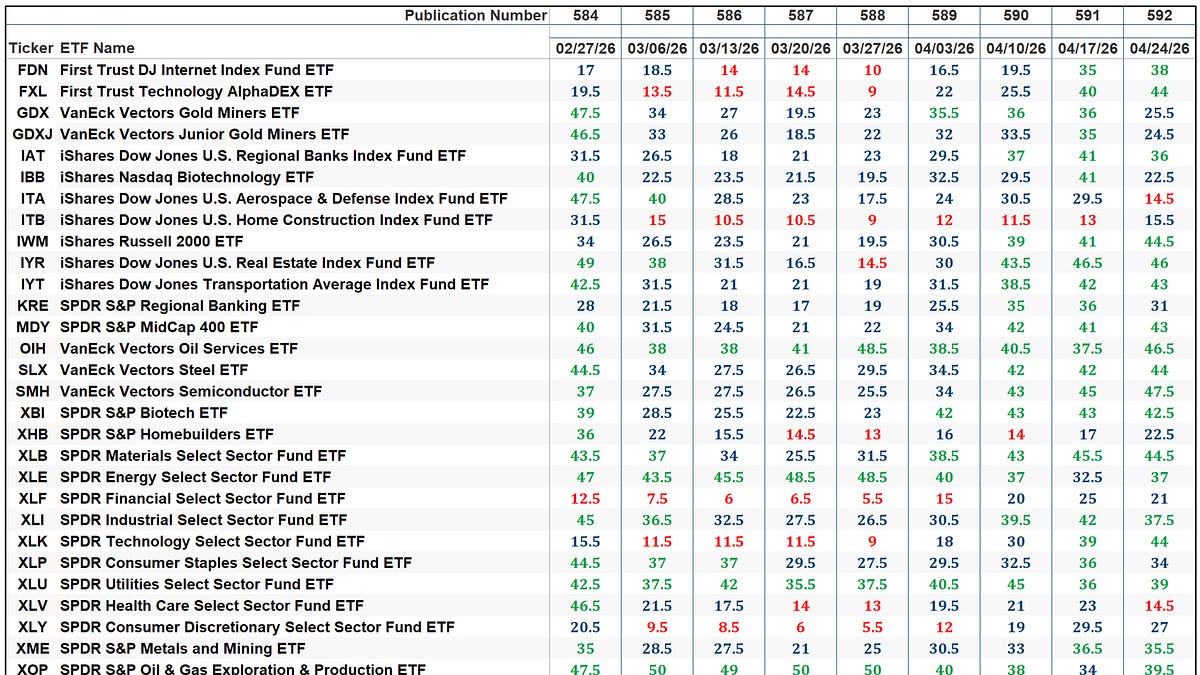
The Total Technical Ranking or “TER” of the U.S. Index and Sector ETFs fell -3.63% last week to 1036 from the recent pinncle of 1075 the previous week which was the best level since February 27th (1103.5).
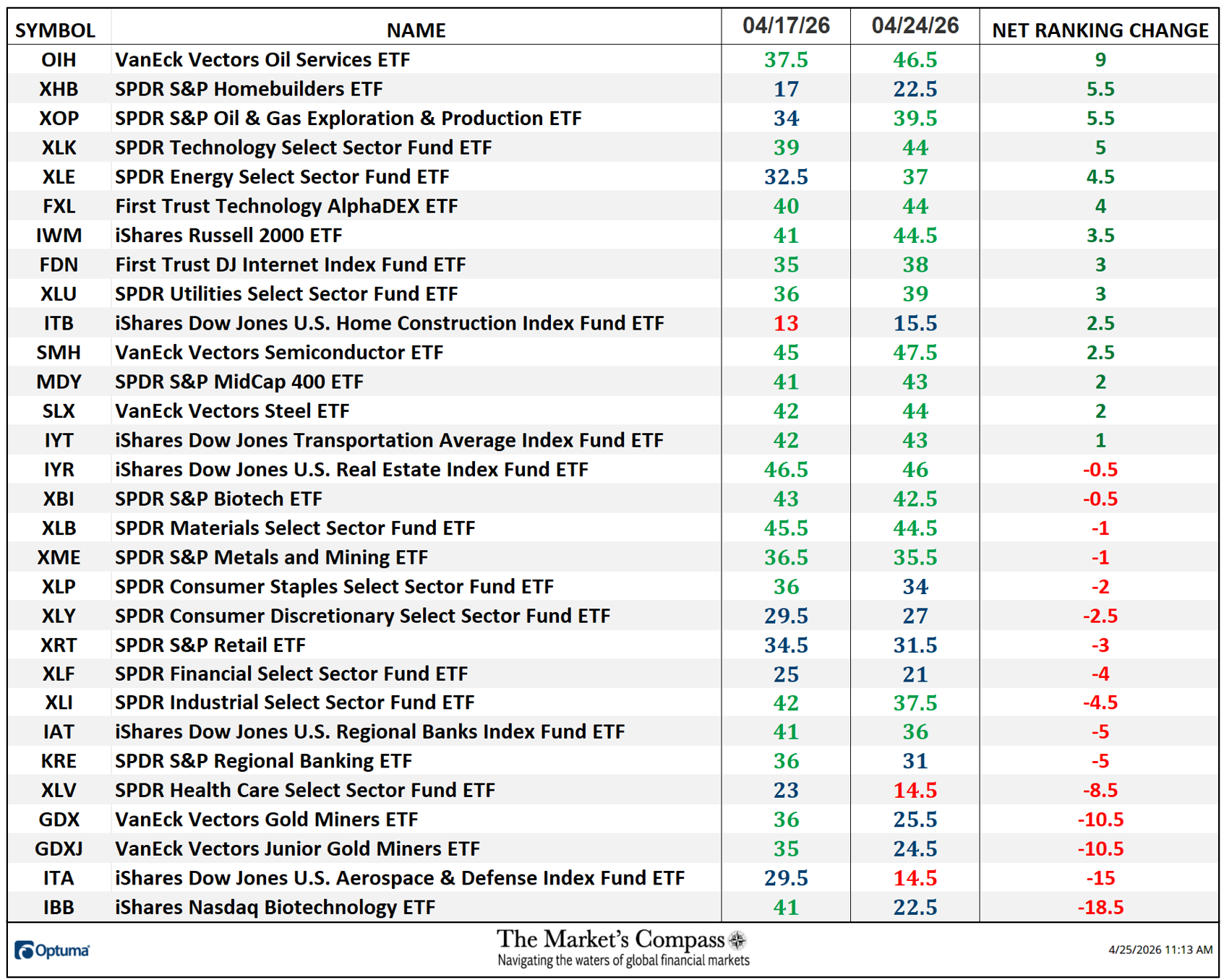
Fourteen ETFs registered increases in their TRs last week, and sixteen ETF TRs fell. Eighteen ETF TRs ended the week in the “green zone” (TRs from 35 to 50), ten ended the week in the “blue zone” (TRs from 15.5 to 34.5) and only two fell into the “red zone” (TRs between 0 and 15). The previous week there were nine in the “green zone”, twenty were in the “blue zone”, and only one was in the “red zone”. The average TR loss on the week was -1.45, reversing the week before average TR gain of +2.62.
The Relative Rotation Graph, commonly referred to as RRGs were developed in 2004-2005 by Julius de Kempenaer. These charts are a unique visualization tool for relative strength analysis. Chartists can use RRGs to analyze the relative strength trends of several securities against a common benchmark, (in this case the SPX Index) and against each other over any given time period (in the case below, daily) over the past three weeks. The power of RRG is its ability to plot relative performance on one graph and show true rotation. All RRGs charts use four quadrants to define the four phases of a relative trend. The Optuma RRG charts uses, From Leading (in green) to Weakening (in yellow) to Lagging (in pink) to Improving (in blue) and back to Leading (in green). True rotations can be seen as securities move from one quadrant to the other over time. This is only a brief explanation of how to interpret RRG charts. To learn more, see the post scripts and links at the end of this Blog.
Not all 30 US Index and Sector ETFs are plotted in this RRG Chart. I have done this for clarity purposes. Those which I believe are of higher technical interest remain.
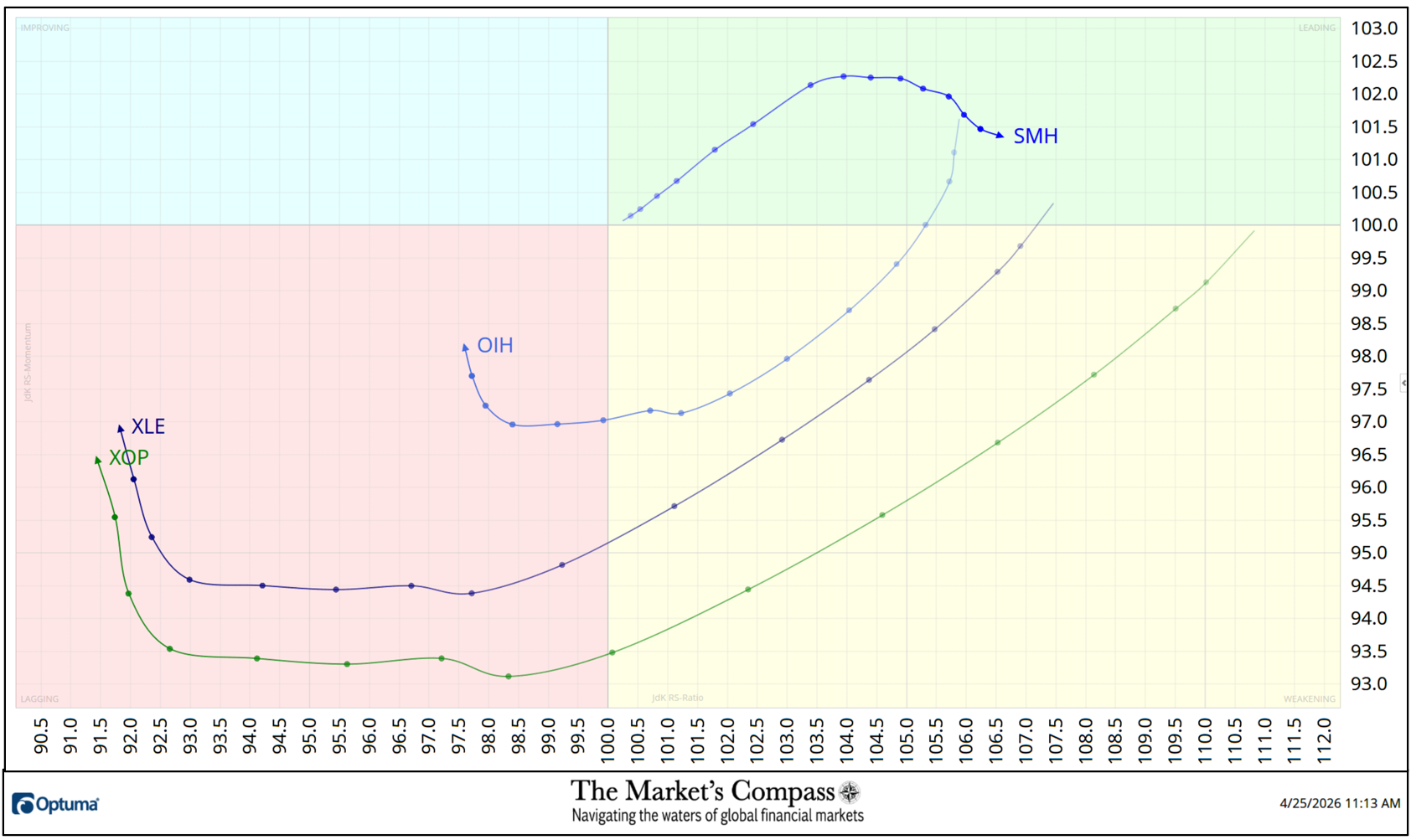
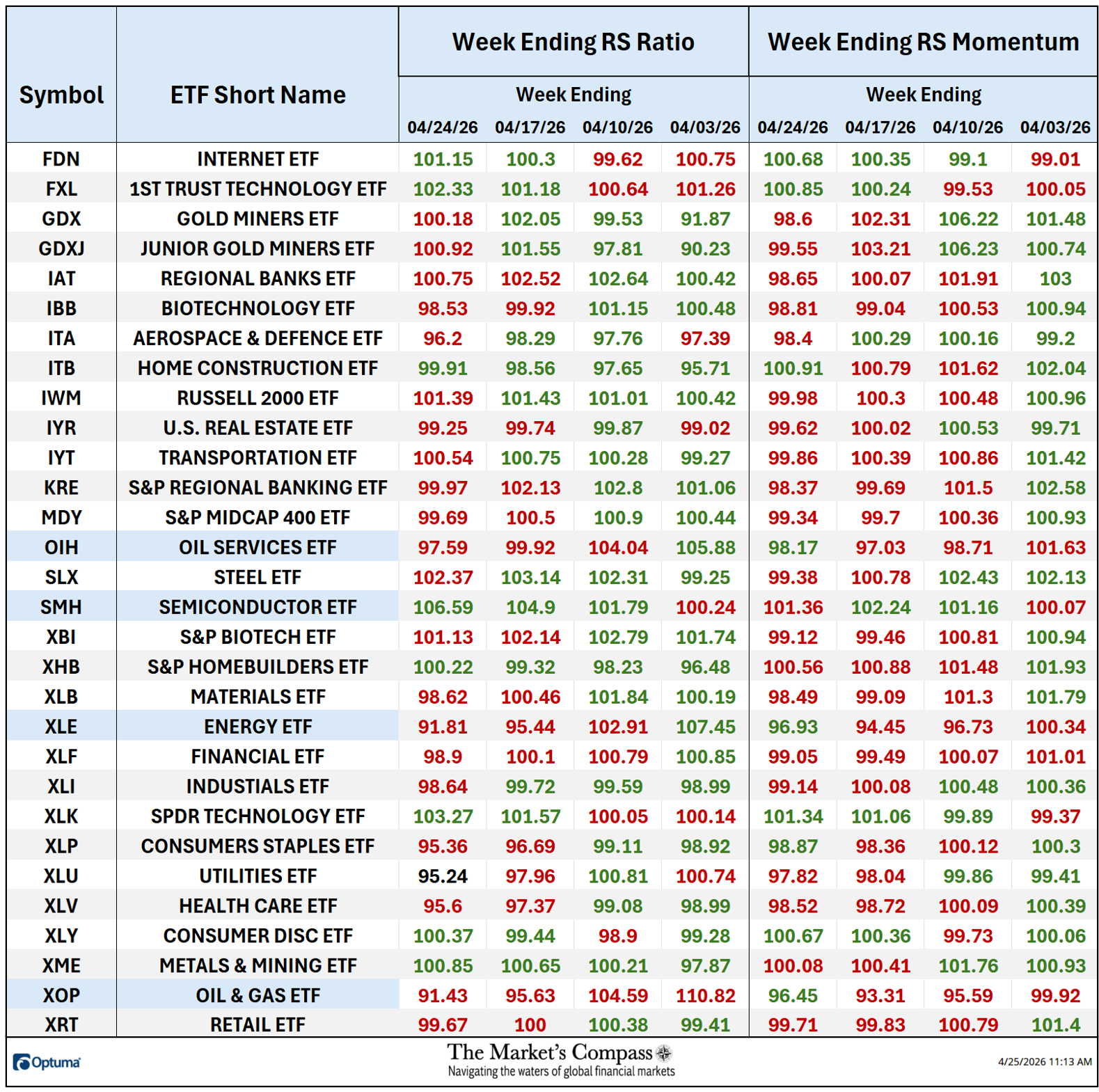
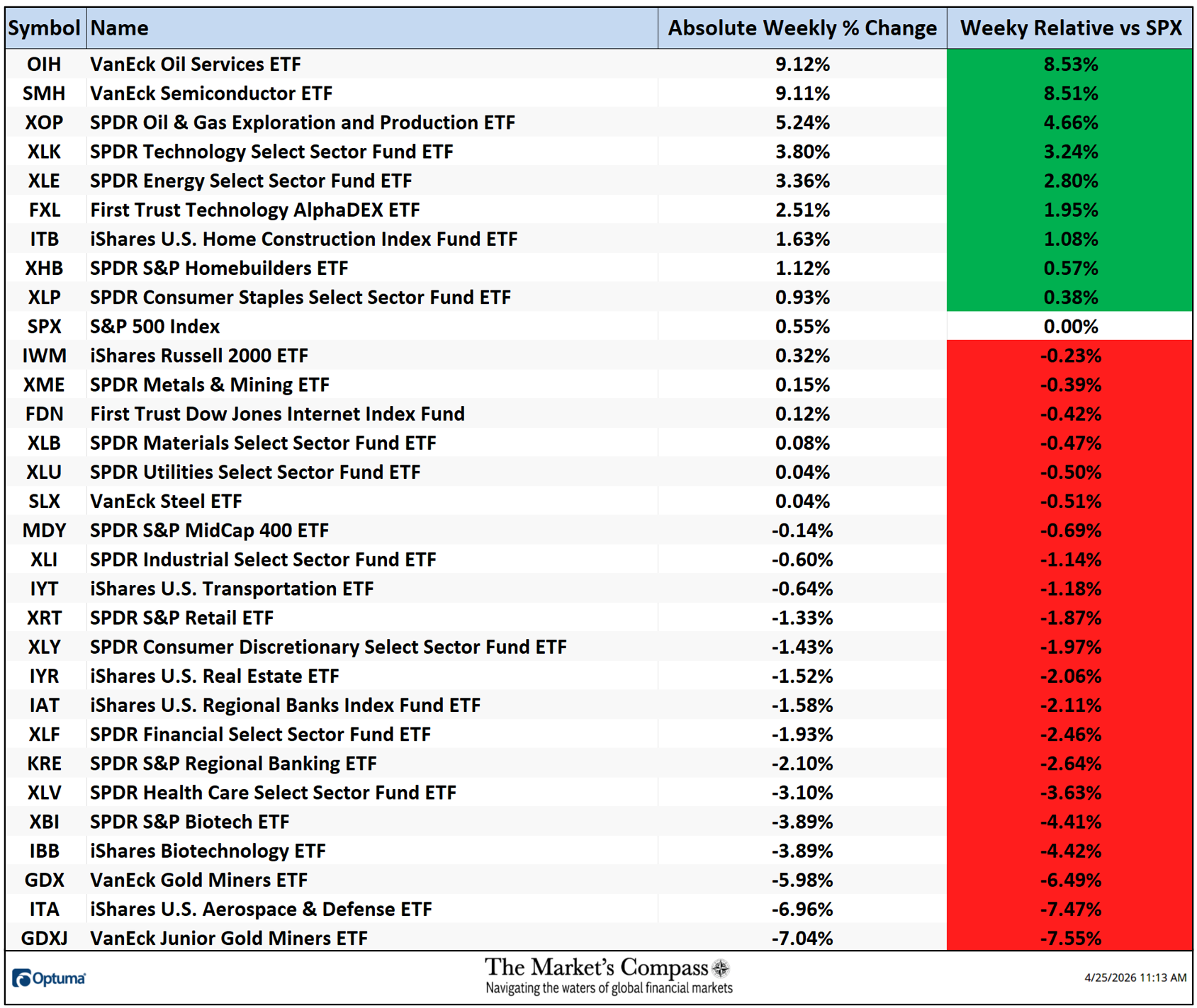
Energy ETFs had a rough two weeks on a Relative Strength and Relative Strength Momentum basis vs. the SPX Index until a recovery last week. The SPDR S&P Oil & Gas Exploration & Production ETF (XOP) led the charge lower three weeks ago by rapidly losing Relative Strength Momentum (note the distance between the daily nodes) before it flattened out in the Lagging Quadrant before it turned higher at the end of last week. The SPDR Energy Select Sector Fund ETF (XLE) fell in concert with the XLE until itrecovered at the end of last week. The VanEck Vectors Oil Services ETF (OIH) was the last of the three to leave the Leading Quadrant behind, but it too dropped through the Weakening Quadrant into the Lagging Quadrant. The VanEck Vectors Semiconductor ETF (SMH) was the standout Relative Strength performer although it began to lose a measure of Momentum last week it nonetheless registered the best Relative Strength vs. the SPX Index at the end of last week at 106.59 (see the Tabulation Table below).
The U.S. Index and Sector ETFs Relative Strength and Relative Strength Momentum “Tabulation Table”.
The Relative Strength and Relative Strength “Tabulation Table” begins with the readings at the end of last week followed by the trailing three weeks that includes the Readings from the last Study. If there has been an improvement in either the Relative Strength Ratio or the Relative Strength Momentum reading on a week-over-week basis I have highlighted it in green. If there has been a contraction in either, it is highlighted in red and an unchanged reading in either will remain in black. The color-coding system serves as a heat map over the past four Friday’s readings highlighting either the continued improvement, deterioration, or stasis vs. the benchmark, the SPX Index.
*The Technical Condition Factors are derived from a calculation of the total Individual US Index and Sector ETF Technical Rankings. What is shown in the excel panel below is the total TCFs of all thirty TRs. A few TCFs carry more weight than the others, such as the Weekly Trend Factor and the Weekly Momentum Factor in compiling each individual TR of each of the 30 ETFs. Because of that, the excel sheet below calculates each factor’s weekly reading as a percentage of the possible total.
To fully understand the construction the of The Technical Condition Factors visit the MC’s Technical Indicators page at www.themarketscompass.com and go to “us etfs”.
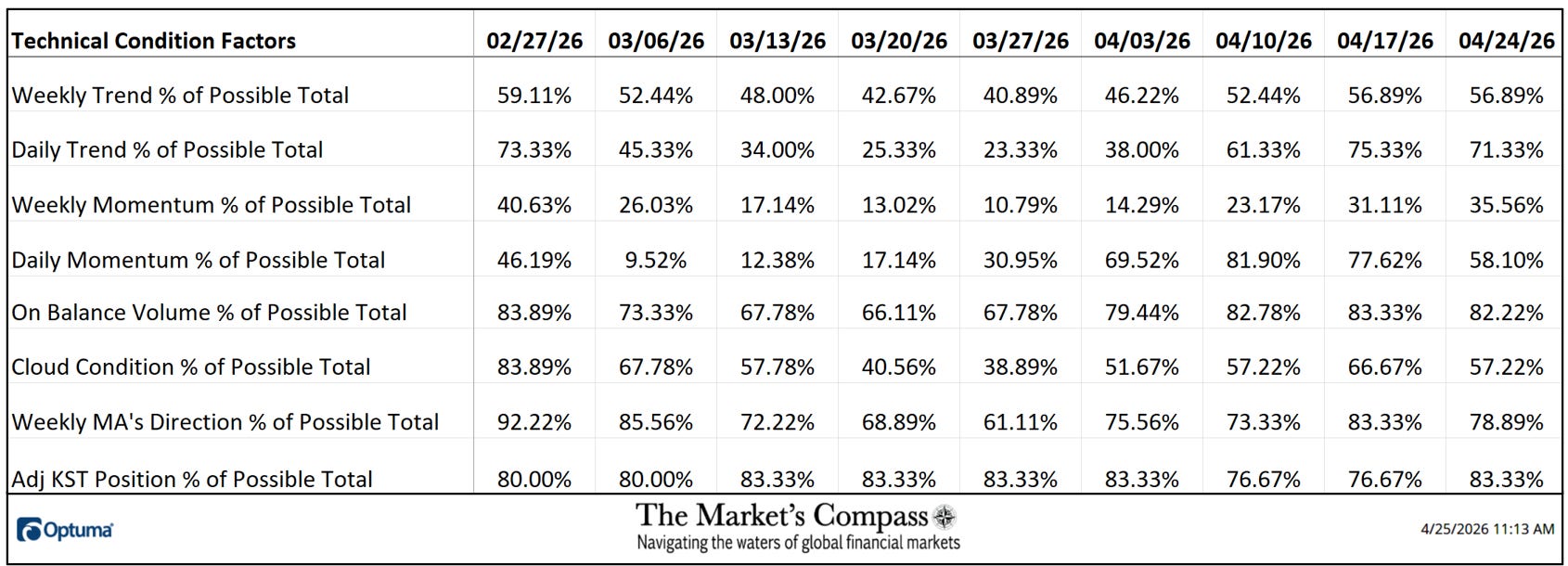
One technical takeaway would be, for example, if the Daily Momentum Condition Technical Factor or DMCTF rose to an extreme between 85% and 100%, it would suggest a short-term overbought condition. Conversely, a reading in the range of 0% to 15% would suggest an oversold condition was developing. Last week a near neutral reading of 58.10% or 122 out of a possible 210 total positive points was registered
As a confirmation tool, if all eight TCFs improve on a week over week basis, more of the 30 ETFs are improving internally on a technical basis confirming a broader market move higher (think of an advance/decline calculation). Conversely if all eight TCFs fell over the week it confirms a move lower in the broader market. Last week two TCFs gained ground, one was unchanged and five fell.
The Weekly Average Technical Ranking (“ATR”) is the average Technical Ranking of the 30 US Index and Sector ETFs we track. It is a confirmation/divergence as well as an overbought/oversold indicator.
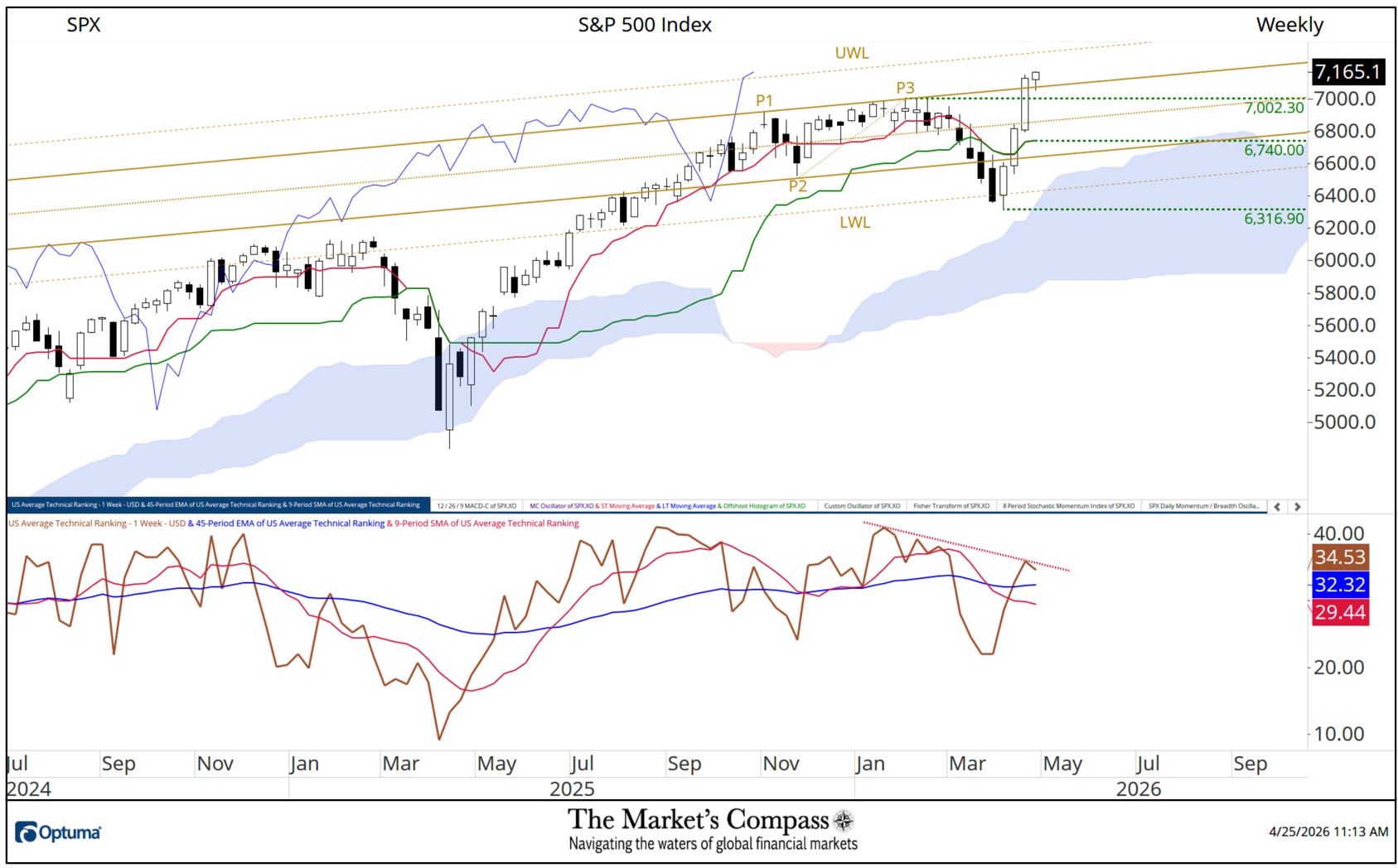
The SPX Index has rallied impulsively over the past four weeks, driving the large-cap Index to a new record weekly closing high of 7,165.10. Not only did the Index overtake the Cluster of potential resistance at the Tenkan and Kijun Plot at 6,7140, it blasted through the previous record weekly closing high and the Upper Parallel (solid gold line) of the Schiff Modified Pitchfork. Although it is folly to argue with the bullish price action there is one secondary technical concern. US ETF Average Technical Ranking has failed to confirm the new highs by printing a lower high (red dashed line). This does not suggest a approaching “death knell” in the index but it deserves monitoring.
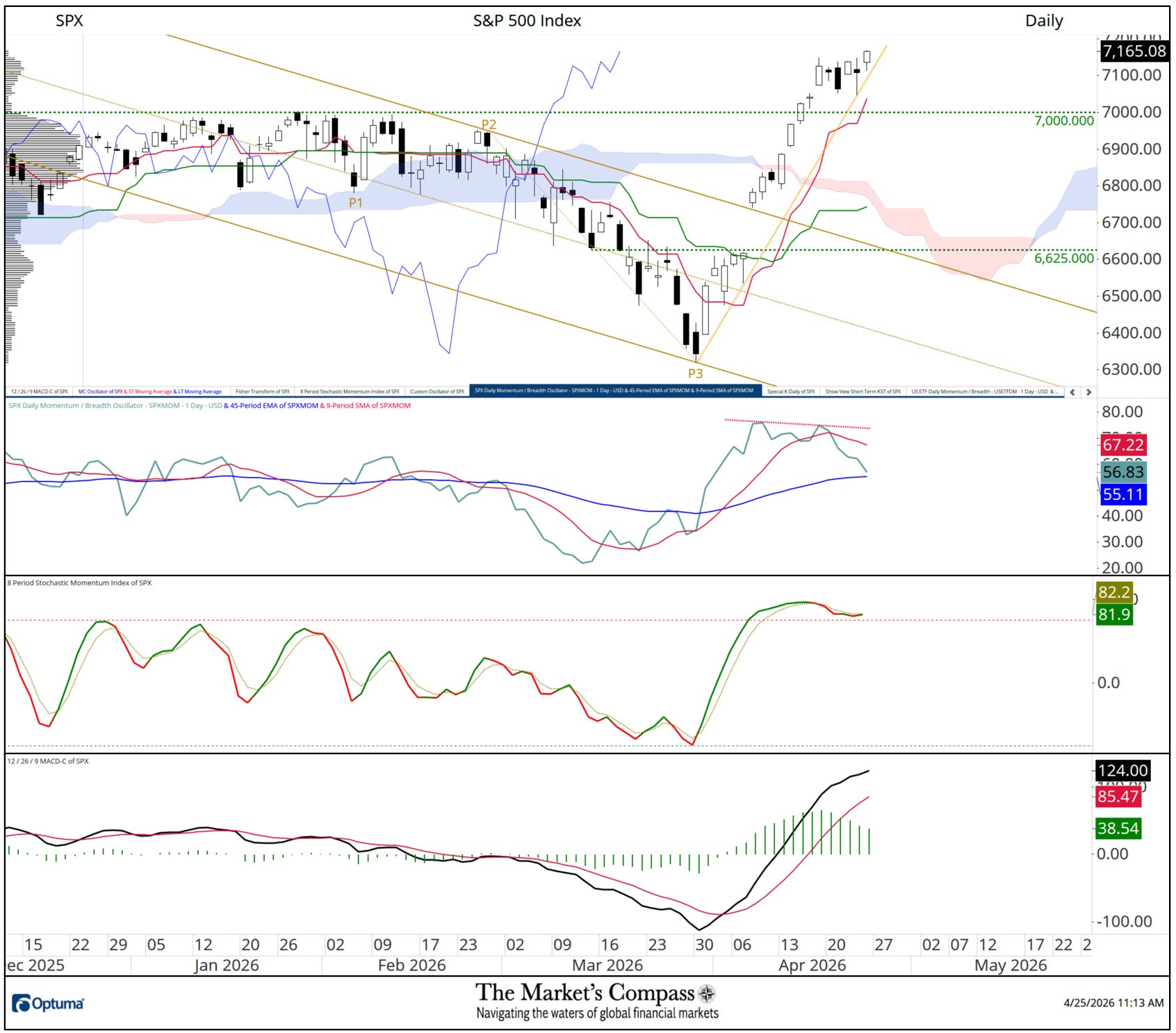
After a brief period of consolidation, prices moved onto a new daily closing high managing to remain in the confines of the strong uptrend (highlighted with the yellow dashed line). All three momentum Oscillators suggest that the index has become stretched. The SPX Momentum / Breadth Oscillator has fallen below its shorter-term moving average from a lower high (red dotted line in the bottom panel). That said only a break of the up-trend followed by a break of key price support at the 7,000 level would hint that a correction of a larger degree was unfolding.