TLDR
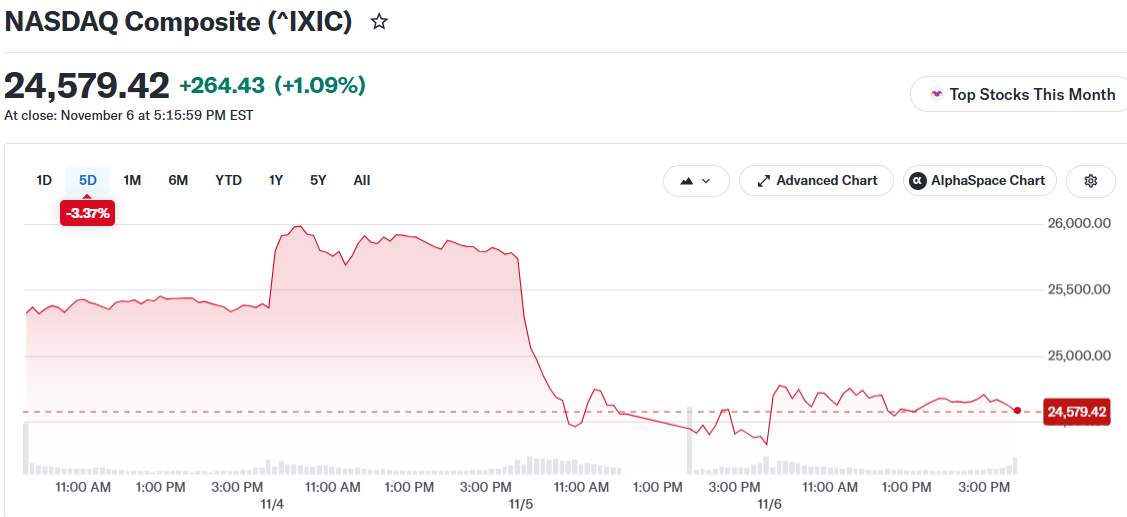
- The Nasdaq rose 1.1% Friday but still lost 3.4% for the week.
- The S&P 500 posted its worst weekly result since June, down 2.7%.
- Chip stocks led the rebound, while the rest of the market stayed flat.
- The US added 165,000 jobs in October, well above the 65,000 expected.
- October consumer price index data is due next week.
Wall Street closed a rough week with a rebound on Friday. It was not enough to erase the losses from earlier in the week.
The Nasdaq Composite gained 1.1% on Friday to finish at 24,579.42. For the week, the index fell 3.4%.
The S&P 500 rose 0.3% to close at 7,376.86. That left it down 2.7% for the week, its worst weekly result since June.
The Dow Jones Industrial Average slipped 0.5%, or 236 points, to 51,285.73. Its weekly loss was 0.9%.
Tech Stocks Drive the Bounce
Friday’s gains were concentrated in technology shares. The ProShares S&P 500 Ex-Technology ETF ended the day flat.
Nvidia rose 3.9% on Friday. AMD jumped 10.8%.
Chip stocks are seeing a bit of a bounce in premarket trading ahead of the nonfarm payrolls report, following Thursday’s AI-led rout:
Micron +9.2%
AMD +8.3%
Intel +6.2%
Nvidia +5%
Broadcom +4.9% pic.twitter.com/IEQwUXVa5e— Wall St Engine (@wallstengine) November 6, 2026

Micron and Sandisk also recovered part of their recent losses. Chip makers had been hit hard in the prior session’s selloff.


Lale Akoner, global market strategist at eToro, said the rebound suggested retail investors were buying the dip in tech. She said she is keeping a very cautious view because buying did not spread beyond the technology sector.
Thursday’s selloff was the week’s sharpest. It erased about $3 trillion in market value and pushed the Nasdaq into a correction.
Investors were worried about a possible slowdown in data center construction and AI spending. The VIX volatility index surged during that session.
Markets also assessed the Democrats’ election sweep on Thursday. Friday’s trading followed that reaction.
Oil prices were in focus as well. Brent crude futures fell below $100 per barrel.
Energy traders continue to watch the war in the Middle East. The risk of a renewed escalation has weighed on sentiment.
The Labor Department also released October jobs data on Friday. The US added 165,000 jobs, compared with the 65,000 economists expected.
The September figure was revised to 60,000 jobs. October’s number was well above both readings.
Investors now turn to next week. They want to see whether Friday’s rally can hold or was only a short bounce.
A new batch of economic data is due, including October’s consumer price index. The report will give a clearer view of inflation.