


Getting into Monero is the easy half. You send some coin, you get XMR, and the ledger does not publish the amount. The reverse trip is where people get stuck. The venues that would have handled it for you a few years ago mostly will not touch XMR now, and the ones that still do have quietly changed the shape of the trade.
If you hold Monero and want Bitcoin, the route matters more than the rate.
Why the exit got harder
Over the past two years a growing number of centralised exchanges have delisted Monero. Some framed it as a compliance decision, some said nothing at all. The direction is one way. EU anti-money-laundering rules are also expected to restrict anonymity-enhancing coins at regulated venues by 2027, which means the remaining custodial options in Europe are on a clock rather than a plateau. So the exit route has shifted toward non-custodial swap services and peer-to-peer trades. Both behave differently from an exchange order book, and if you expect one and get the other you will be annoyed at the wrong things.
Fixed rate or floating rate
Every swap service offers one of two rate models, and choosing badly is the most common self-inflicted cost on this trip.
A floating rate is priced when your deposit is confirmed. You get whatever the market gives at that moment. If XMR moves in your favour during the wait, you keep the upside. If it moves against you, that is yours too.
A fixed rate locks the number when you create the order. The service absorbs the market risk for the length of the window and charges you for that in a slightly worse quote. The window is short, usually minutes. Miss it and the order typically reverts to floating or refunds.
The rule I use is simple. Small amounts, floating. Amounts where a couple of percent would actually bother you, fixed. If you are moving XMR during a volatile stretch, fixed is worth the spread, because Monero’s confirmation timing is not fast enough to outrun a bad candle.

Confirmation timing, and why the wait feels long
Monero’s block cadence is slower than people expect. Most services wait for several confirmations on an XMR deposit before they release the Bitcoin side. That is where the wait comes from, and it is not the service stalling. It is the deposit chain.


Then the Bitcoin leg has to be broadcast and confirmed on its own schedule, with its own fee market. So the honest expectation for an XMR to BTC swap is a wait measured in tens of minutes, not seconds. If nothing has moved in the first few minutes, nothing is wrong yet.
Two things genuinely go wrong. First, you send from an exchange withdrawal that arrives later than you expected, and the fixed-rate window has already lapsed. Second, you underestimate the Bitcoin fee environment and the output sits unconfirmed for hours. Neither is fixable after the fact.
The mechanics of a non-custodial swap
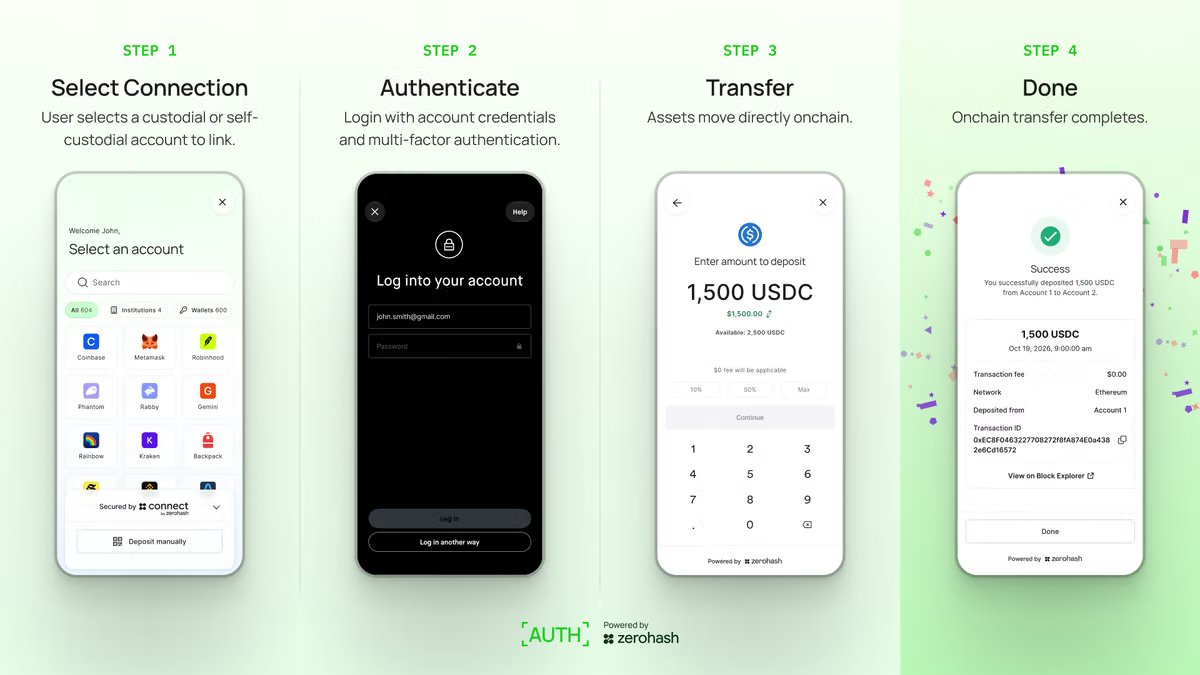
The flow is the same across most services. You give a destination Bitcoin address, you get a one-time Monero deposit address, you send, you wait, the BTC lands. Nobody holds a balance for you between those steps.
A few things are worth doing every time:
- Set a refund address. This is the single most useful field on the form. If the swap cannot complete, whether the rate window lapsed or the amount arrived outside the accepted range, the funds return to an address you control instead of sitting in support limbo.
- Check the minimum and maximum before you send, not after.
- Copy the destination address from your wallet, then verify the first and last characters on the order page.
Services in this category, GhostSwap among them, run without an account, an email or a signup, and the output asset goes straight to the address you specified. The order page for exchange Monero to Bitcoin shows the rate, the minimum and the window before you commit anything.
One disclosure worth making plainly, because most bury it. Deposits that trip the licensed liquidity partner’s automated AML screening can be held pending review. It is uncommon, and a refund address is your protection when it happens, but anyone telling you the risk is zero is wrong.
What changes when the value lands on a transparent chain
This is the part people think about last and should think about first. Monero’s ledger does not expose amounts, senders or recipients. Bitcoin’s exposes all three, permanently.
The moment your BTC arrives, that output exists in public. Anything you do with it afterwards, consolidating it with older coins, sending it to an exchange deposit address, paying someone who keeps records, links that output to whatever else you have touched. The privacy you had on the Monero side does not travel with the value; it ends where the private ledger ends.
So think about the destination before the swap, not after. A fresh address in a wallet that does not automatically merge it with unrelated coins is a different outcome from an address you have already published. And be clear-eyed: no swap is untraceable, and any service that tells you otherwise is wrong. What a non-custodial swap gives you is no account and no identity document, which is worth having. It is not invisibility.