• Latest
  • Trending
When the Book Keeps Moving. What Hyperliquid Lets Outsiders Reconstruct.

When the Book Keeps Moving. What Hyperliquid Lets Outsiders Reconstruct.

July 29, 2026
Crypto Exchanges Push into Stocks and Commodities: CoinGecko Report

Crypto Exchanges Push into Stocks and Commodities: CoinGecko Report

July 29, 2026
Why Japan Recognized XRP’s Potential So Early: Evernorth Breaks It Down

Why Japan Recognized XRP’s Potential So Early: Evernorth Breaks It Down

July 29, 2026
USDC deposits and withdrawals now available on Injective!

USDC deposits and withdrawals now available on Injective!

July 29, 2026
Lucid (LCID) Stock; Soars 21% on Saudi Royal Backing, Yet $1.4B Cash Burn Raises Red Flags

Lucid (LCID) Stock; Soars 21% on Saudi Royal Backing, Yet $1.4B Cash Burn Raises Red Flags

July 29, 2026
Live updates: Bitcoin clears $64,000 in Asia hours ahead of Fed decision

Live updates: Bitcoin clears $64,000 in Asia hours ahead of Fed decision

July 29, 2026
What Happens When Two Miners Find a Block at the Same Second? Inside an Orphan Race

What Happens When Two Miners Find a Block at the Same Second? Inside an Orphan Race

July 29, 2026
Dynamic Fees in AMMs: When the Signal Matters

Dynamic Fees in AMMs: When the Signal Matters

July 29, 2026
Trade.xyz to Reimburse SK Hynix Perp Traders After Price Anomaly

Trade.xyz to Reimburse SK Hynix Perp Traders After Price Anomaly

July 29, 2026
Next XRP Move May Break $1 Threshold, Ethereum (ETH) Already Eyes $2,000, Near Protocol (NEAR) Is Out of Trend: Crypto Market Review

Next XRP Move May Break $1 Threshold, Ethereum (ETH) Already Eyes $2,000, Near Protocol (NEAR) Is Out of Trend: Crypto Market Review

July 28, 2026
  • Privacy Policy
Wednesday, July 29, 2026
MtRushmoreCrypto - Where Crypto Rocks
  • Home
  • Top News
  • Crypto
  • Crypto Technical Analysis
  • About Us
No Result
View All Result
  • Home
  • Top News
  • Crypto
  • Crypto Technical Analysis
  • About Us
No Result
View All Result
Logo
No Result
View All Result
Home Crypto Technical Analysis

When the Book Keeps Moving. What Hyperliquid Lets Outsiders Reconstruct.

J_News by J_News
July 29, 2026
in Crypto Technical Analysis, Top News
0
When the Book Keeps Moving. What Hyperliquid Lets Outsiders Reconstruct.
0
SHARES
0
VIEWS
Share on FacebookShare on Twitter


Hyperliquid first shows up as a price story.

Related articles

Crypto Exchanges Push into Stocks and Commodities: CoinGecko Report

Crypto Exchanges Push into Stocks and Commodities: CoinGecko Report

July 29, 2026
Why Japan Recognized XRP’s Potential So Early: Evernorth Breaks It Down

Why Japan Recognized XRP’s Potential So Early: Evernorth Breaks It Down

July 29, 2026

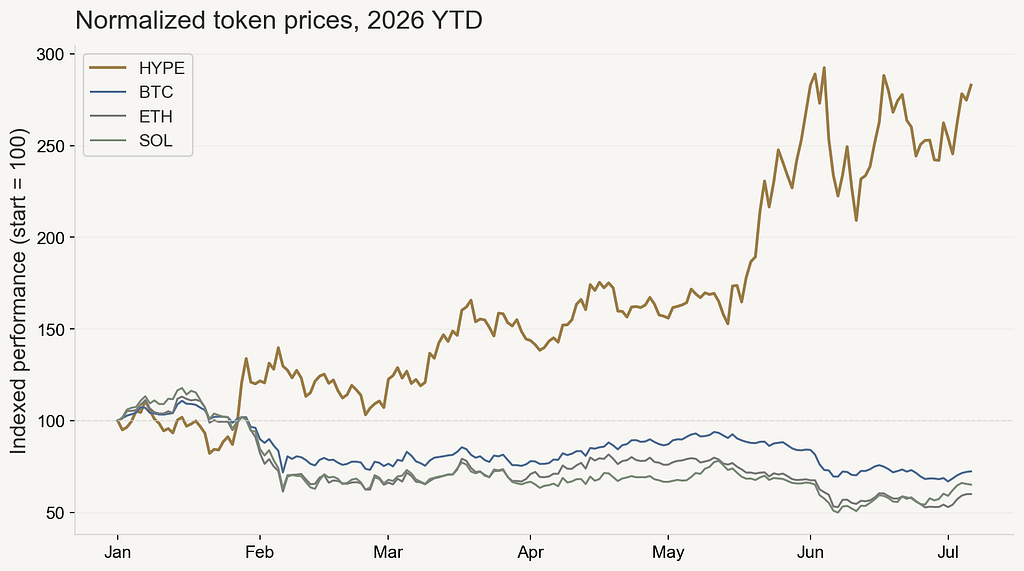
In a weak crypto tape, HYPE kept attracting attention while the usual majors looked heavier. That does not prove anything about the venue’s market structure. A token chart is not an audit trail; price performance compresses flows, incentives, listings, buybacks, leverage, and narrative into one line.

But it does explain why the venue is worth opening.

The better question is not whether HYPE went up. It is what kind of market object sits underneath that attention, and whether the public book exposes enough state for an outsider to reconstruct the moving surface of the market, rather than just another exchange UI.

Fig. 0. Normalized token price performance, indexed to 100 at 2026–01–01 (CoinGecko daily close, through 2026–07–06 UTC; end-indexed HYPE 283, BTC 72, ETH 60, SOL 65). This is attention context only, not evidence of venue quality or market-structure superiority.

A pool snapshot and a book snapshot answer different questions, and this post is about what happens after the snapshot. A single l2Book pull is a measurement. An audit trail is a sequence.

That distinction came out of prior AMM work, where the recurring blocker was simpler: you cannot reason forward from a market state until the state object is defined. If the object is unstable, over-abstracted, or mixed in with hidden assumptions, a later monitor, rule engine, or learning loop risks fitting artifacts instead of mechanism. Hyperliquid became the next test case because its public CLOB surface looked archivable enough to try.

The AMM side has its own version of this problem. Bunni is a compact hook-side example: its post-mortem traced the failure to Bunni’s own accounting logic, not to Uniswap v4’s core swap math. Once a pool adds custom defense logic on top of the AMM, that logic becomes part of the state machine an auditor has to follow, and it needs sequence-level audit, not a single balance check.

Hyperliquid hands the same problem a different object. There are no pool reserves or hook accounting here. The state is a moving book: posted depth, trades, funding, open interest, mark-oracle premium, and reference mids pulled from other venues.
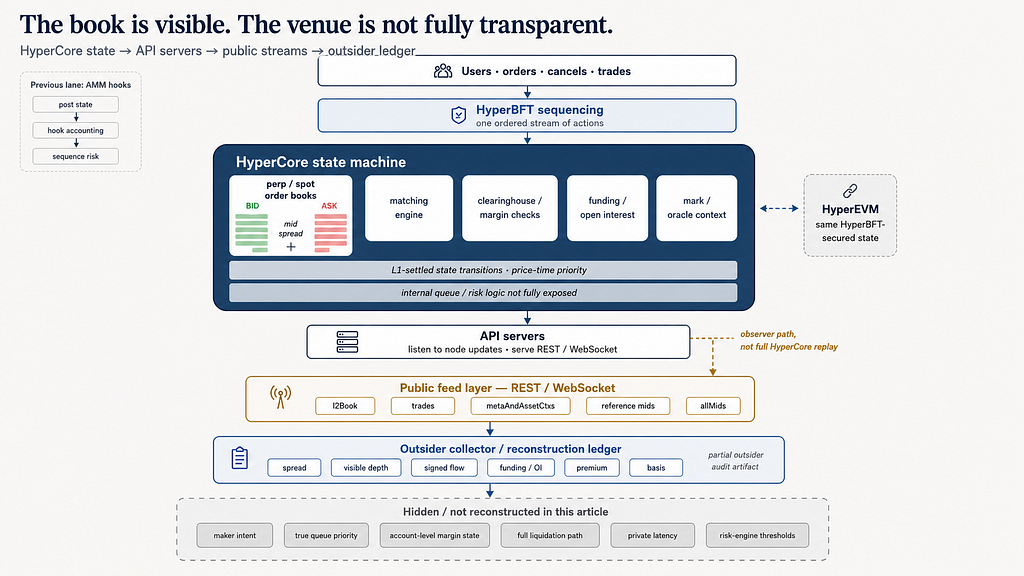
Fig. 1. Hyperliquid-centered observability map. HyperCore exposes book state through API servers and public streams; the outsider ledger archives that surface and labels what stayed outside the artifact.

Hyperliquid starts from a different object

The static contrast is familiar: callable inventory versus posted depth.

An AMM pool can usually be inspected as a compact state object: reserves, liquidity range, fee tier, swap logs, pool price. A CLOB has to be watched as a moving surface instead — book updates, trades, funding, open interest, mark-oracle context, and basis against reference mids. Cancels and reposts often show up only as depth that moved between snapshots, with no event marking the change.

On the AMM side, the market object is still a pool: reserves, curve state, LP accounting, fee logic, and now hook state. Hooks and dynamic fees are an attempt to make that passive inventory more conditional, which is closer to what a CLOB order already is by default — posted at a price, for a size, until the maker cancels, until it fills, or until risk changes.

On the CLOB side, the object is posted depth backed by active makers, margin rules, funding, and a risk engine, not a pool defending passive inventory. The visible stress signals follow from that: spread, visible depth, signed flow, funding, OI, mark-oracle premium, and basis. Neither surface is being scored as safer here; the object being inspected is just different.

Hyperliquid documents the book as HyperCore / L1 state with price-time priority matching. The public info API and WebSocket path are the outsider observer path – twenty visible levels per side, callable from outside, which is what makes the book L1-settled, API-observable, and self-archivable in the first place. Archive the public streams, normalize the rows, and label what never entered the artifact.

What the architecture makes observable

This matters because the public stream is not the same thing as HyperCore itself. HyperCore includes the order books internally; what the API exposes is an observer path, not a byte-for-byte replay of that internal state.

Three layers fall out of that. Public feeds — l2Book, trades, metaAndAssetCtxs, external reference mids – are the first. Derived metrics come second: spread, visible depth, imbalance, signed flow, funding/OI movement, mark-oracle premium, cross-venue basis. The third layer stays hidden regardless of how long you collect: maker intent, true queue priority, private latency, account-level margin state, the full liquidation path, risk-engine thresholds.

Reconstructing the moving book

There is no point reasoning forward from a book state if the book state itself is only a screenshot, so the first task here is reconstruction, not prediction.

The workflow is plain: archive public streams, normalize them into book-timestamped rows, join nearest-prior perp context and reference mids, compute derived fields, and mark gaps instead of filling them.

A local collector on BTC, ETH, and SOL pulls WebSocket l2Book and trades, periodic metaAndAssetCtxs, and Binance/Bybit perp mids as external anchors. Basis here is a reconciliation signal, not a mispricing verdict. The output is a partial outsider artifact – one row per book observation with spread, visible depth bands, sixty-second signed flow, joined meta fields, cross-market basis, and gap flags.

Any future monitor, rule engine, or agent that uses this data inherits the same observable boundary: it cannot act on maker intent or hidden margin state, because those never entered the artifact to begin with.

The figures below use a 7-day (168 h) collection window (2026–07–13T00:00Z-2026–07–19T23:59Z; 112,626 BTC book rows) — the longest fully continuous stretch in a roughly two-week collection run, with no reference-feed or WS outages inside it. One joined row from the middle of the run shows how the fields line up: at 11:59:44 UTC on Jul 16, spread 0.16 bps; visible 10 bps depth ~$10.6M; sixty-second signed flow ~−$79k; funding joined from the nearest-prior meta poll; HL mid within a few bps of Binance and Bybit mids.

This row does not explain maker intent, queue priority, or liquidation causality. What it does show is narrower: the book, trade tape, perp context, and reference mids join into one defensible outsider market-state artifact.
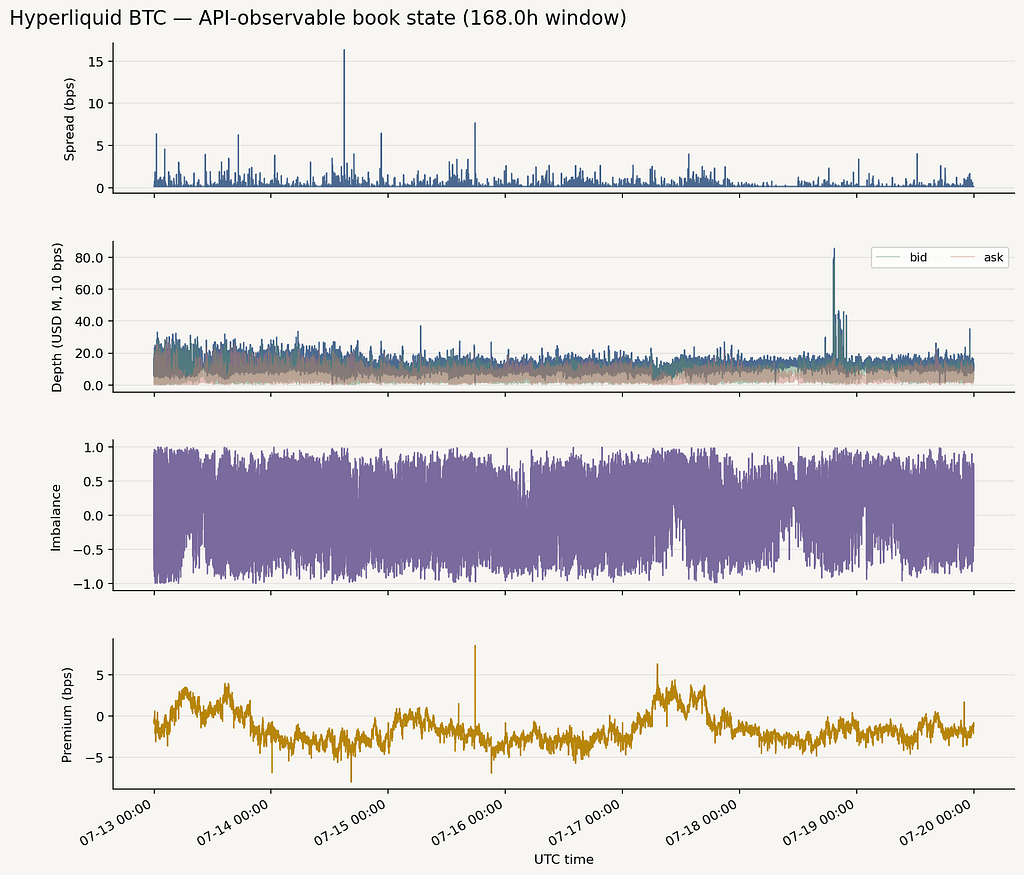
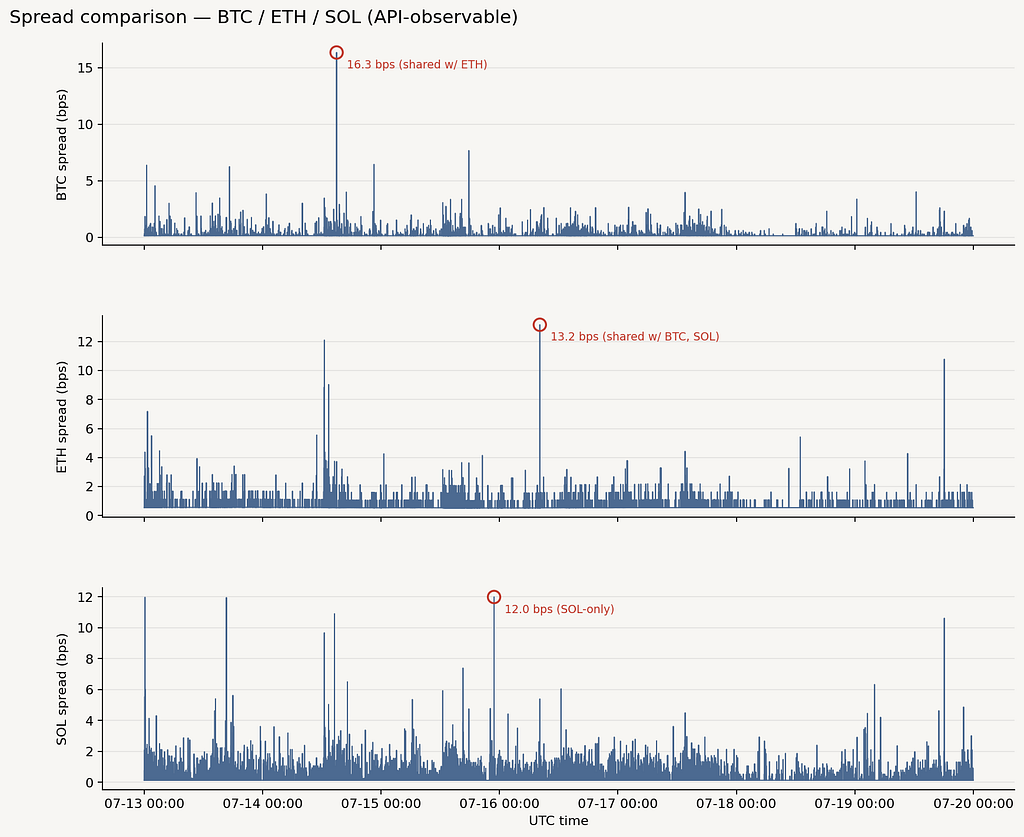
Fig. 2. BTC book state over the 7-day window (Jul 13–19, 2026), left deliberately raw and unsmoothed: the claim is continuity of capture, not a trend. Look for three things — no gaps anywhere across all four panels; a quiet baseline (sub-bps spread, ~10–30M depth) punctuated by a few real outliers (the ~16bps spread spike, the ~$85M depth spike); and imbalance sitting near ±1 most of the time rather than centered at zero. Premium is joined from periodic `metaAndAssetCtxs` polls (~45s cadence), so its step changes reflect that polling interval, not book-level noise.
Fig. 3. Spread comparison across BTC, ETH, and SOL over the same 7-day window. Each panel’s single largest spike is circled and checked against the other two coins at that same instant: BTC’s spike partially carried into ETH, ETH’s own peak coincided with mild moves in both BTC and SOL, and SOL’s peak was idiosyncratic — no elevation in BTC or ETH at all. The point is not the spike size but whether stress is shared across books or confined to one.
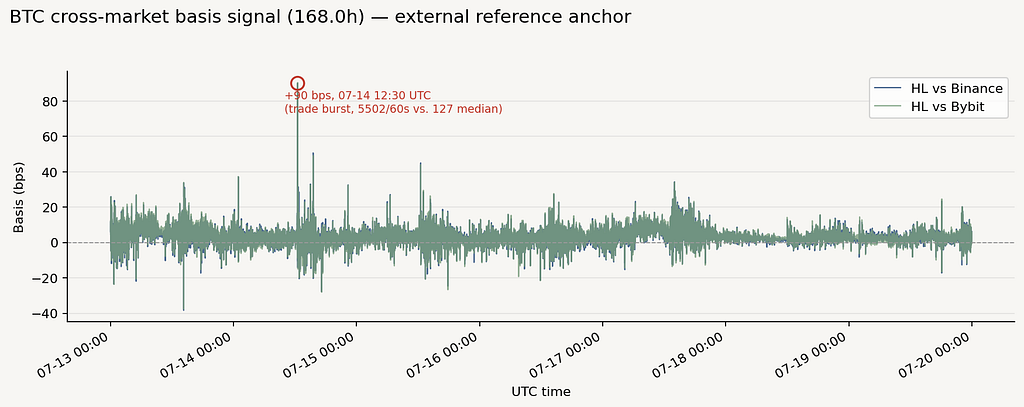
Fig. 4. BTC cross-market basis vs Binance (and Bybit where joined). A reconciliation overlay only, not proof of mispricing or an arbitrage opportunity. The window’s largest excursion (+90 bps, Jul 14 12:30 UTC) lines up with a genuine trade-volume burst on Hyperliquid itself: 60s trade count jumped to 5,502 against a 127 median, with HL’s own mid running ~0.9% ahead of Binance/Bybit for under 30 seconds before reference caught back up. That timing coincides with the June CPI release (8:30am ET / 12:30 UTC), reported softer than expected, and with BTC’s move higher after early-day weakness tied to Iran-related geopolitical pressure — a plausible read, but this ledger only confirms the timing coincidence and the OI-flat, volume-spike shape; the CPI-driven-buying explanation itself comes from news coverage, not from anything in the collected rows. Open interest barely moved, which is more consistent with fast directional buying than a liquidation cascade, but that is still an inference from the shape of the row, not a traced cause.

Liquidity, leverage, and pricing stress

The joined row above reads through four surfaces. Liquidity: sub-bps spread with thick visible near-mid depth. Pressure: heavy sell-side signed flow, with the visible book leaning ask-heavy while takers hit the bid. Leverage: funding from the joined meta poll, with no obvious crowding signal in a single row. Pricing stress: HL mid tracking external mids rather than drifting wide.

Rule-based flags on the ledger are stress screens, not accusations. Over the 7-day window, percentile flags rest on a firmer baseline than the original 32 h pilot, but still short of the 30-day target; a 30-day archive remains the actual target for any market-structure claim.

What remains hidden

Even with a running collector, the outsider still does not see maker intent, true queue priority, private latency, account-level margin distribution, the full liquidation path, or risk-engine thresholds.

Public depth can disappear without a trade. Public fills carry no maker labels. Cross-venue basis diverges for reasons that are not automatically mispricing or routing alpha — the CPI row above is one instance of a basis spike with a plausible but unverified explanation.

That incompleteness is not a footnote to clean up later; it is most of the point of keeping the ledger at all. What the ledger is good for is not seeing everything, but recording exactly what entered the artifact and what stayed outside it, and doing that continuously enough that the boundary itself becomes measurable over time instead of guessed at from one screenshot.

Reconstructing the public book is useful not because it restores the venue’s full internal truth, but because it turns an opaque stream into a state object that can be monitored, compared, and stress-tested — the spread and depth spikes in Fig. 2 double as alert thresholds, and the flat-OI-plus-volume-burst read in Fig. 4 is one instance of narrowing an explanation, not just describing a chart. That is enough to support alerting, event attribution, and execution or risk decisions, without needing a completed picture of maker intent behind them.

Closing

The point was never Bunni itself. It is the object an auditor has to follow.

On the AMM side, the live questions are dynamic fees, hooks, and LP loss surfaces — state that only makes sense read across a sequence. On the CLOB side, the live questions are a moving book, funding and OI, mark-oracle premium, basis, and the hidden venue state behind them. Both lanes fail the same way when the audit object is left vague: reasoning forward from a screenshot.

A public book does not solve the audit problem so much as relocate it. The next check on this data is not a bigger dashboard — it is whether a 30-day version of the same ledger holds up the CPI-basis read above as a repeatable pattern (macro print → volume burst → basis spike → flat OI) rather than a one-window coincidence.

Appendix: collection and reproducibility

  • Window: 2026–07–13 → 2026–07–19 UTC (7 days, 168 h). Coins: BTC, ETH, SOL — roughly 112,600 rows each. This was the longest stretch in a ~2-week collection run with no reference-feed or WebSocket outage inside it; those gaps show up elsewhere in the run as missing rows in Fig. 4, not as a fabricated basis reading.
  • Limitations: visible l2Book levels only; nearest-prior join for perp meta and reference mids, dropped rather than carried forward past 5 minutes of staleness; a 7-day run, not yet the 30-day market-structure study this points toward.
  • Reproduction: Gist appendix (archive_io.py, collect_ws_ledger.py, collect_ref_mids.py, build_ledger.py, build_figures.py).
  • Bunni post-mortem: blog.bunni.xyz
  • Jul 14 CPI/BTC context: CoinDesk

This post was originally published on my personal blog: https://egpivo.github.io/2026/07/26/when-the-book-keeps-moving.html


When the Book Keeps Moving. What Hyperliquid Lets Outsiders Reconstruct. was originally published in The Capital on Medium, where people are continuing the conversation by highlighting and responding to this story.


Source link

ShareTweetShareShare

Related Posts

Crypto Exchanges Push into Stocks and Commodities: CoinGecko Report

Crypto Exchanges Push into Stocks and Commodities: CoinGecko Report

by J_News
July 29, 2026
0

Intense competition from traditional brokerage and decentralized exchanges is pushing crypto exchanges to expand beyond digital assets into tokenized stocks,...

Why Japan Recognized XRP’s Potential So Early: Evernorth Breaks It Down

Why Japan Recognized XRP’s Potential So Early: Evernorth Breaks It Down

by J_News
July 29, 2026
0

Japan built a functioning banking system based on XRP while the rest of the world spent years debating the legal status...

USDC deposits and withdrawals now available on Injective!

USDC deposits and withdrawals now available on Injective!

by J_News
July 29, 2026
0

Funding USDC deposits and withdrawals via Injective are now live. Deposit link below. Make sure to deposit your tokens into...

Lucid (LCID) Stock; Soars 21% on Saudi Royal Backing, Yet $1.4B Cash Burn Raises Red Flags

Lucid (LCID) Stock; Soars 21% on Saudi Royal Backing, Yet $1.4B Cash Burn Raises Red Flags

by J_News
July 29, 2026
0

TLDRs; Lucid shares jumped after Saudi Prince Alwaleed revealed a 5% stake in the EV maker. The investment boosted sentiment...

Live updates: Bitcoin clears $64,000 in Asia hours ahead of Fed decision

Live updates: Bitcoin clears $64,000 in Asia hours ahead of Fed decision

by J_News
July 29, 2026
0

Bitcoin’s annualized 30-day implied volatility index, BVIV, the so-called fear gauge, continues to hover below 40%, well below highs above...

Load More

Enter your email address:

Delivered by FeedBurner

Quick Navigate

  • Home
  • Crypto
  • Crypto Technical Analysis
  • Top News
  • Thank You
  • Store
  • About Us

Top News

NFP, FOMC minutes, and CPI span the next two weeks

Inside Cardano’s ‘Van Rossum’ hard fork, and how it matters for users

Senator Warren Requests 2026 Reporting for Trump’s Crypto Earnings after $1.4B Disclosure

© 2021 mtrushmorecrypto - Crypto Related News Blog

We use cookies on our website to give you the most relevant experience by remembering your preferences and repeat visits. By clicking “Accept”, you consent to the use of ALL the cookies.
Do not sell my personal information.
Cookie SettingsAccept
Manage consent

Privacy Overview

This website uses cookies to improve your experience while you navigate through the website. Out of these, the cookies that are categorized as necessary are stored on your browser as they are essential for the working of basic functionalities of the website. We also use third-party cookies that help us analyze and understand how you use this website. These cookies will be stored in your browser only with your consent. You also have the option to opt-out of these cookies. But opting out of some of these cookies may affect your browsing experience.
Necessary
Always Enabled
Necessary cookies are absolutely essential for the website to function properly. These cookies ensure basic functionalities and security features of the website, anonymously.
CookieDurationDescription
cookielawinfo-checkbox-analytics11 monthsThis cookie is set by GDPR Cookie Consent plugin. The cookie is used to store the user consent for the cookies in the category "Analytics".
cookielawinfo-checkbox-functional11 monthsThe cookie is set by GDPR cookie consent to record the user consent for the cookies in the category "Functional".
cookielawinfo-checkbox-necessary11 monthsThis cookie is set by GDPR Cookie Consent plugin. The cookies is used to store the user consent for the cookies in the category "Necessary".
cookielawinfo-checkbox-others11 monthsThis cookie is set by GDPR Cookie Consent plugin. The cookie is used to store the user consent for the cookies in the category "Other.
cookielawinfo-checkbox-performance11 monthsThis cookie is set by GDPR Cookie Consent plugin. The cookie is used to store the user consent for the cookies in the category "Performance".
viewed_cookie_policy11 monthsThe cookie is set by the GDPR Cookie Consent plugin and is used to store whether or not user has consented to the use of cookies. It does not store any personal data.
Functional
Functional cookies help to perform certain functionalities like sharing the content of the website on social media platforms, collect feedbacks, and other third-party features.
Performance
Performance cookies are used to understand and analyze the key performance indexes of the website which helps in delivering a better user experience for the visitors.
Analytics
Analytical cookies are used to understand how visitors interact with the website. These cookies help provide information on metrics the number of visitors, bounce rate, traffic source, etc.
Advertisement
Advertisement cookies are used to provide visitors with relevant ads and marketing campaigns. These cookies track visitors across websites and collect information to provide customized ads.
Others
Other uncategorized cookies are those that are being analyzed and have not been classified into a category as yet.
SAVE & ACCEPT
No Result
View All Result
  • Home
  • Top News
  • Crypto
  • Crypto Technical Analysis
  • About Us

© 2021 mtrushmorecrypto - Crypto Related News Blog