


TLDR
- Oil prices fell Thursday, pulling back after a sharp jump the day before.
- President Trump said the ceasefire with Iran is over and warned of more military action.
- The U.S. military struck about 90 targets in Iran early Thursday.
- Iran retaliated with strikes on U.S. bases in Kuwait and Bahrain.
- Shipping authorities raised the threat level in the Strait of Hormuz to severe.
Oil prices turned lower on Thursday. This came after a sharp jump in prices the day before.
Brent crude fell 0.7% to $77.54 a barrel by early Thursday morning. U.S. West Texas Intermediate crude dropped 0.6% to $73.09 a barrel.
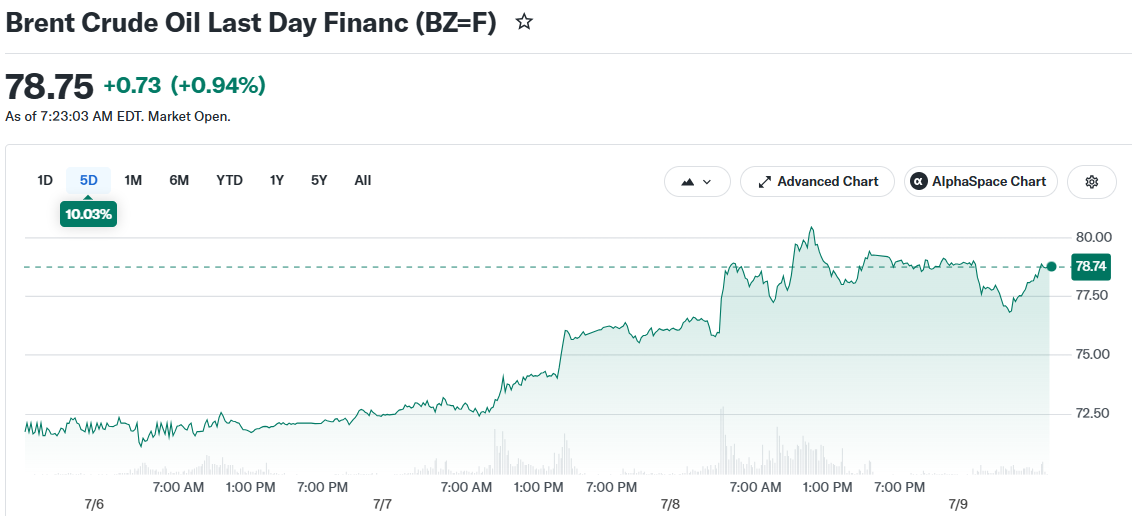
Both prices are still much higher than earlier in the week. Brent and WTI each jumped more than 8% on Wednesday.
That jump happened after President Donald Trump said the ceasefire with Iran was over. He also warned of more military action against Iran.
Renewed Strikes in the Gulf
The U.S. military carried out new strikes on Iran early Thursday. U.S. Central Command said it hit close to 90 military targets.
BREAKING: President Trump says “it will get much worse” if Iran attacks ships in the Strait of Hormuz again. pic.twitter.com/kn8xRu6mA7
— The Kobeissi Letter (@KobeissiLetter) July 8, 2026
These targets included air defense systems and coastal surveillance equipment. Drone storage sites were also hit.

Central Command said the goal was to weaken Iran’s ability to strike ships in the Strait of Hormuz. Officials described the strikes as a response to Iran’s attacks on three oil tankers in the strait.
Iran struck back. Its military hit what it called U.S. military bases in Kuwait and Bahrain.
Iran’s Revolutionary Guards Corps also warned of more attacks on American sites in the Gulf. This would happen if the U.S. strikes again.
Several commercial ships have already been attacked near the Strait of Hormuz in recent days. The Joint Maritime Information Center, which is led by the U.S., calls the threat to shipping severe.
The International Maritime Organization has told ships to use extreme caution when passing through the strait. This is one of the most used routes for oil shipments in the world.
What Traders Are Watching Next
Oil exports from the Gulf had been slowly recovering after a ceasefire last month. Analysts now say new attacks could stop that recovery.
Analysts at ANZ said the recent fighting has added a war-risk premium back into oil prices. They warned that a full breakdown of the U.S.-Iran understanding could disrupt Gulf oil exports again.
ANZ also pointed to tighter fuel markets. Russia extended limits on diesel exports through July.
U.S. government data showed another large drop in supplies of diesel and gasoline. Fuel exports from the U.S. hit a record at the same time.
Commercial crude supplies in the U.S. rose last week. But the government also released more oil from its emergency reserve.
On the charts, WTI crude is testing its 200-day moving average near $74. That price briefly went higher before falling back.
Analysts say oil would need to break above $85 for the rally to look bigger than a short-term bounce. If WTI falls below $67, prices could fall toward the mid-$50s.
For now, oil is being pushed up by war risk in the Gulf, not by an actual shortage of supply.
4th of July Flash Sale – 50% OFF!
Celebrate Independence Day by investing in your future. For a limited time, get 50% OFF a Knockout Stocks membership and unlock our latest high-conviction stock picks, powered by our proprietary KO Score algorithm.
You’ll also get access to our long-term investment ideas and shorter-term trade opportunities, helping you identify potential opportunities before the crowd.
Sign up to Knockout Stocks today and get 50% OFF to unlock the full list of premium stock picks.
Use coupon code SPECIAL50 for your exclusive discount.
Offer ends soon. Don’t miss out!
