



sUSDS can be posted as collateral to borrow against, and in markets that support it, keep earning the Sky Savings Rate while it does. That is the appeal. Liquidation is the catch, so this is an advanced move, not the simple way to use sUSDS.

Here is the honest version up front. You can use sUSDS as collateral in DeFi money markets to borrow against, and because it can keep accruing the Sky Savings Rate (SSR) while posted, your collateral can stay productive instead of sitting idle. Borrowing against collateral also means you can be liquidated, so this is an advanced activity, not the default way to hold sUSDS.
If your goal is simply to save, you do not need any of this. You can hold sUSDS and let it earn. This guide is for experienced DeFi users who understand leverage and want liquidity without selling their position.
sUSDS is the yield-generating form of USDS, and the Sky Savings Rate is the governance-set yield it accrues. That detail matters here, because the whole reason to post sUSDS rather than a plain dollar is that, in supporting markets, it can keep earning while it works as collateral.
Borrowing against sUSDS carries liquidation risk. Simply holding it does not.
First, the honest warning
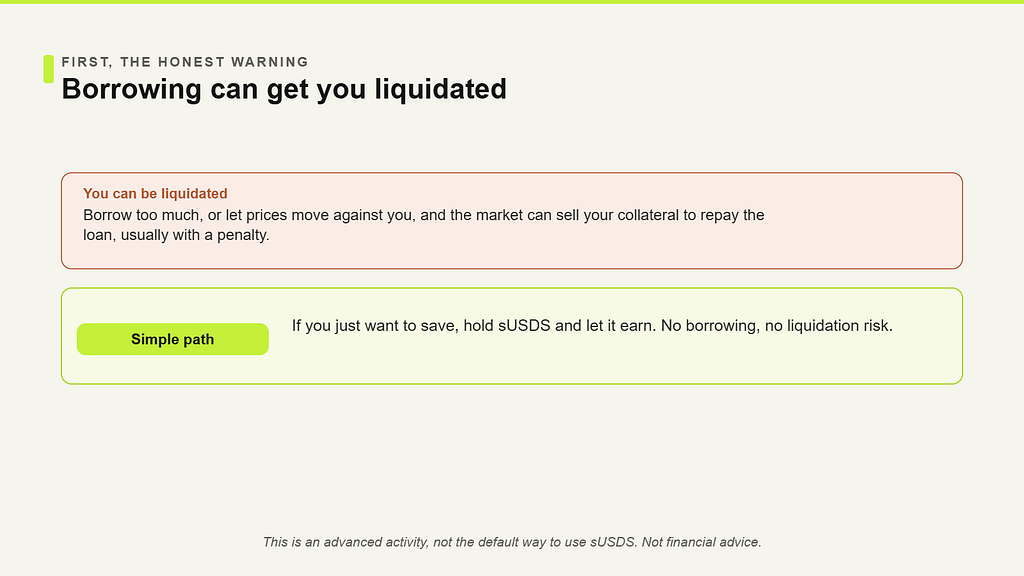
Borrowing against collateral means you can be liquidated. If you borrow too much, or the price of what you borrowed rises, or your collateral value falls, the market can sell your collateral to repay the loan, usually with a penalty. That is a real loss, and it is the defining risk of this activity.
Do not assume the position is safe just because sUSDS is a stable collateral. You are borrowing another asset against it, and that asset can move. A stable collateral lowers one variable, it does not remove liquidation risk. This article is educational and is not financial advice.
What does using sUSDS as collateral mean?
Using sUSDS as collateral means supplying it into a DeFi money market and borrowing another asset against it. You still own the sUSDS. It is locked as collateral until you repay what you borrowed, at which point you can withdraw it. This is possible because sUSDS is composable, a standard onchain token that other DeFi protocols can accept.
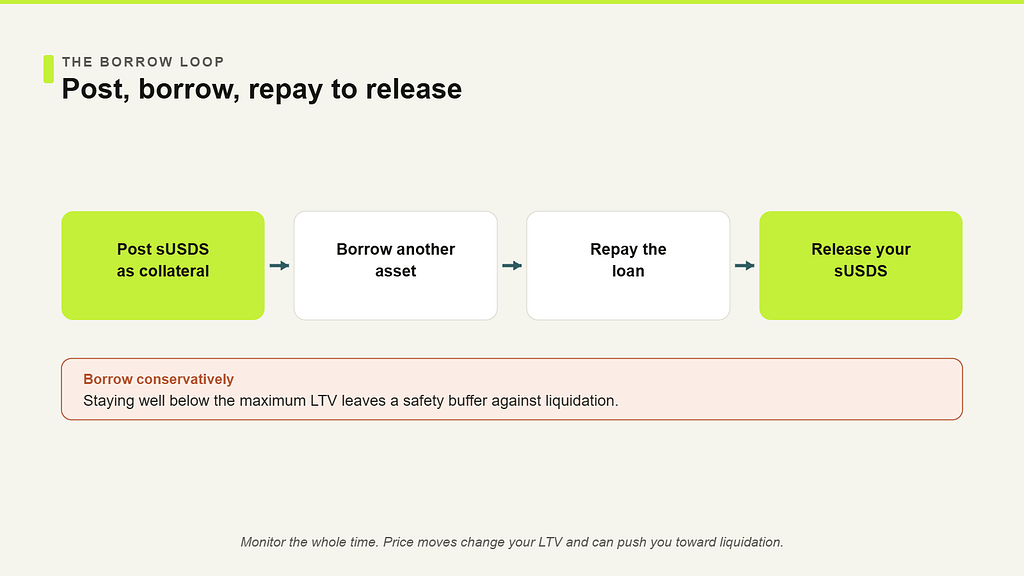
The loop is straightforward: post collateral, borrow against it, repay to release it. The complexity lives entirely in managing the gap between what you posted and what you owe.
Why use sUSDS as collateral?
The appeal is liquidity without selling, plus productive collateral. You can borrow against your sUSDS instead of redeeming or selling it, so you keep your position and any exposure you wanted to hold. That is useful if you need cash for something else but do not want to exit.
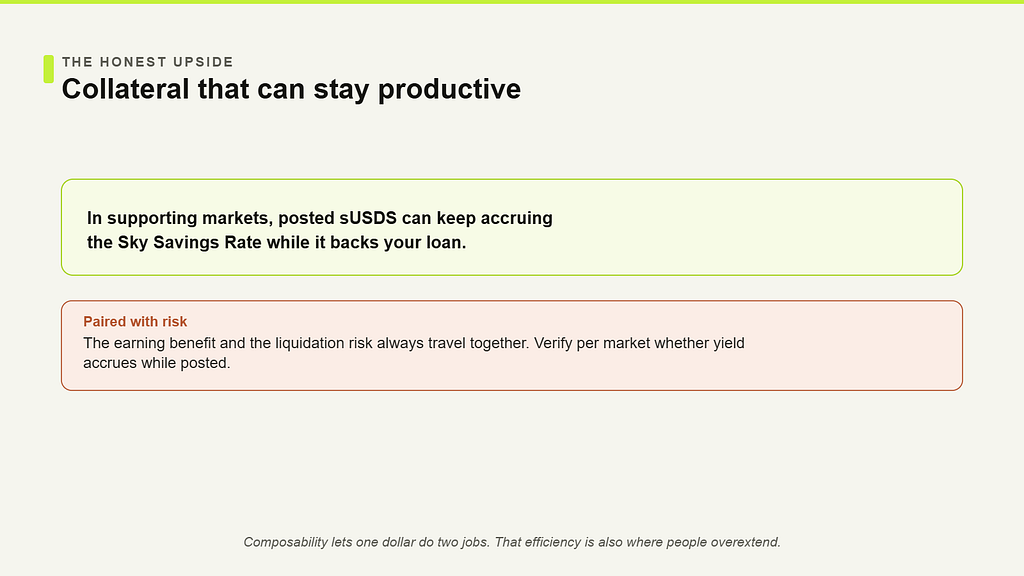
The differentiated part is that, in markets that support it, your sUSDS can keep accruing the Sky Savings Rate while it sits as collateral, so it is not idle capital. That is what composability makes possible, and you should verify it market by market before relying on it. Every one of these benefits comes attached to liquidation risk, and the two travel together.
In supporting markets, sUSDS can keep earning the Sky Savings Rate while posted as collateral.
How LTV and liquidation work
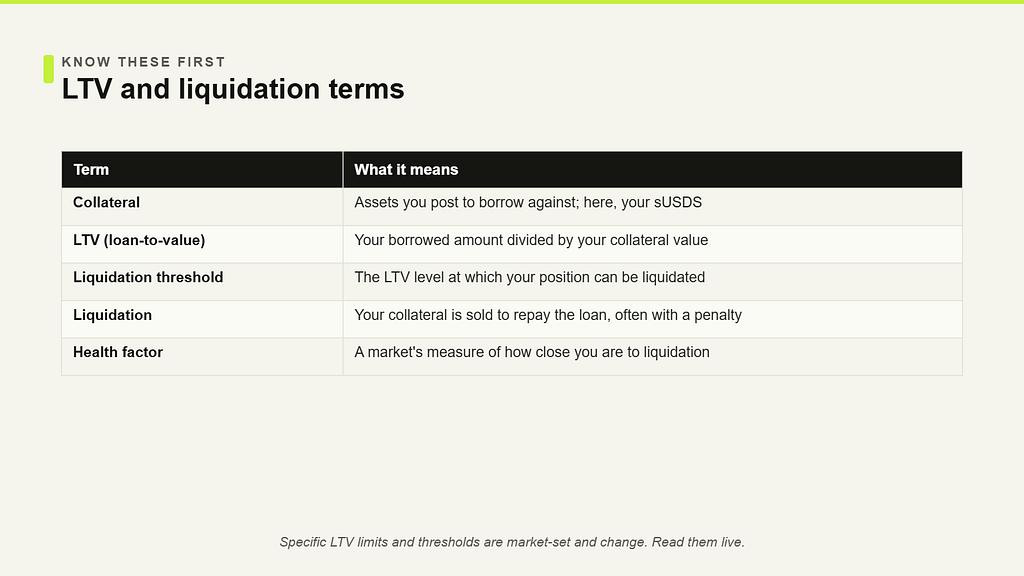
Loan-to-value, or LTV, is your borrowed amount divided by your collateral value, and it is the number that decides whether you are safe. Each market sets a maximum LTV and a liquidation threshold. If your LTV climbs past that threshold, because you borrowed too much, the borrowed asset rose in price, or your collateral value fell, your collateral is liquidated to repay the loan, often with a penalty.
The mechanics are worth knowing in plain terms before you borrow anything:
- Collateral. The assets you post to borrow against, here your sUSDS.
- LTV (loan-to-value). Your borrowed amount divided by your collateral value.
- Liquidation threshold. The LTV level at which your position can be liquidated.
- Liquidation. Your collateral is sold to repay the loan, often with a penalty.
- Health factor. A market’s measure of how close your position sits to liquidation.
Specific maximum-LTV and threshold numbers are set by each market and change, so read them live rather than trusting a figure in any article, including this one.
How to use sUSDS as collateral, step by step
Treat every step as reversible and monitor the whole time. This is the opposite of set-and-forget.
- Choose a DeFi money market that accepts sUSDS as collateral, such as Spark within the Sky ecosystem, and verify current listings and parameters in the live app.
- Supply your sUSDS as collateral in that market.
- Borrow another asset against it, staying well below the maximum LTV to leave a safety buffer. This is the step where liquidation risk begins.
- Monitor your position, because price moves change your LTV and can push you toward liquidation.
- Repay what you borrowed to release and withdraw your sUSDS.
I would not name a specific market’s parameters here, because they are market-set and shift.
Confirm which venues accept sUSDS, the current limits, and whether yield accrues while posted, before you commit.
Managing the risk
Safety in this activity is mostly about restraint and attention. Borrow conservatively and keep a large buffer below the maximum LTV, so an ordinary price move does not put you near the threshold. Monitor actively, because a position that was safe last week can drift.
Know your market’s liquidation threshold and penalty before you borrow, remember that borrowing a volatile asset raises the risk, and have a plan to add collateral or repay if your position moves the wrong way. None of this is financial advice, and no buffer makes liquidation impossible.
Is this right for you?
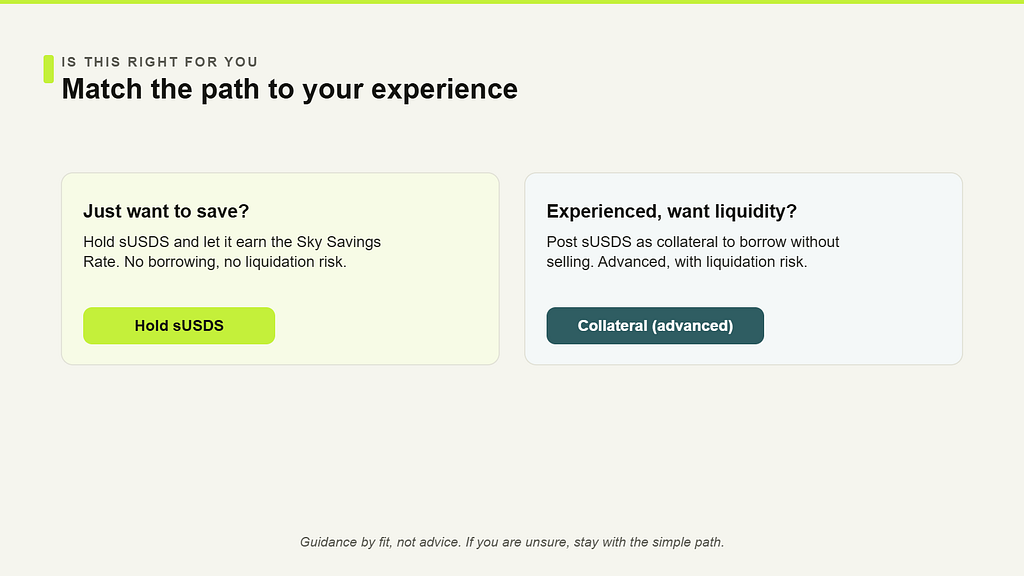
Using sUSDS as collateral suits experienced DeFi users who understand liquidation and want liquidity without selling their position. If your goal is simply to save, you do not need this. You can hold sUSDS and let it earn the Sky Savings Rate, with no borrowing and no liquidation risk at all.
The right choice depends on your experience and your risk tolerance. If you are unsure, that uncertainty is itself an answer: stay with the simple path.
A final thought
The genuinely interesting thing about sUSDS as collateral is that it lets one dollar do two jobs, earning the Sky Savings Rate while backing a loan. That is a real efficiency, and it is also exactly where people overextend, because a productive position can lull you into borrowing more than you should.
If you want the efficiency, borrow far below the limit and watch the position like it is a job, because for the duration of the loan, it is. If you just want your dollars to grow quietly, the set-and-forget path of simply holding sUSDS is right there, and it carries none of this. Verify current market parameters at the source before you post anything.
Have you used a stablecoin as collateral, and how did you set your buffer? I would like to read your approach in the responses.
Frequently asked questions
Can you use sUSDS as collateral?
Yes. sUSDS is composable and can be supplied as collateral in DeFi money markets that accept it, to borrow other assets against. You keep ownership until you repay and withdraw.
Where can I use sUSDS as collateral?
In DeFi money markets that list it, such as Spark within the Sky ecosystem. Verify current venues, limits, and whether yield accrues while posted in the live app before committing.
Does sUSDS keep earning while used as collateral?
In markets that support it, yes, it can keep accruing the Sky Savings Rate while posted. This varies by market, so confirm it for the specific venue rather than assuming.
What is LTV?
Loan-to-value is your borrowed amount divided by your collateral value. Each market sets a maximum LTV and a liquidation threshold, and crossing the threshold triggers liquidation.
Can I be liquidated with a stable collateral?
Yes. Borrowing a volatile asset, or borrowing too much, can still push your LTV past the liquidation threshold even when your collateral is a stable coin like sUSDS.
Do I have to use sUSDS as collateral?
No. If you just want to save, simply hold sUSDS and let it earn. Using it as collateral is an advanced, optional activity for people who understand the risk.
How to Use sUSDS as Collateral in DeFi (Risks Included) was originally published in The Capital on Medium, where people are continuing the conversation by highlighting and responding to this story.