

• Latest
  • Trending
FE covenants would put Bitcoin’s spending rules inside the signing key, with no protocol change. The cryptography they need is not yet practical.

FE covenants would put Bitcoin’s spending rules inside the signing key, with no protocol change. The cryptography they need is not yet practical.

November 18, 2026
Micron Technology (MU) Stock Pops 3% After SK Hynix Posts Record Quarter

Micron (MU) Stock Rises Premarket as Nvidia Memory Commitments Hit $390B

November 18, 2026
CoinStats Oct 16 to Nov 16 Updates: P/L and New Chains

CoinStats Oct 16 to Nov 16 Updates: P/L and New Chains

November 18, 2026
Phoenix Signs and Apparel Announces New Phoenix Location – November 2026

Phoenix Signs and Apparel Announces New Phoenix Location – November 2026

November 18, 2026
Binance Hacker Moves Over $105 Million of Stolen Ethereum

Binance Hacker Moves Over $105 Million of Stolen Ethereum

November 18, 2026
Goldman Sachs Boosted Its XRP ETF Stake to $144M, Then XRP Crashed

Goldman Sachs Boosted Its XRP ETF Stake to $144M, Then XRP Crashed

November 18, 2026
Zcash targets $1,134 as ZEC futures demand rises

Zcash targets $1,134 as ZEC futures demand rises

November 18, 2026
Solana Foundation Backs CoinGecko, Crypto Data Giant Expands Into Trading and DeFi

Solana Foundation Backs CoinGecko, Crypto Data Giant Expands Into Trading and DeFi

November 18, 2026
Aave App Launches on TRON, Bringing USDT Deposits to Mobile Users on Android and iOS

Aave App Launches on TRON, Bringing USDT Deposits to Mobile Users on Android and iOS

November 18, 2026
Dogecoin (DOGE) Price Holds Key Support as Mid-Size Holders Keep Buying

Dogecoin (DOGE) Price Holds Key Support as Mid-Size Holders Keep Buying

November 18, 2026
  • Privacy Policy
Wednesday, November 18, 2026
MtRushmoreCrypto - Where Crypto Rocks
  • Home
  • Top News
  • Crypto
  • Crypto Technical Analysis
  • About Us
No Result
View All Result
  • Home
  • Top News
  • Crypto
  • Crypto Technical Analysis
  • About Us
No Result
View All Result
Logo
No Result
View All Result
Home Crypto

FE covenants would put Bitcoin’s spending rules inside the signing key, with no protocol change. The cryptography they need is not yet practical.

J_News by J_News
November 18, 2026
in Crypto, Top News
0
FE covenants would put Bitcoin’s spending rules inside the signing key, with no protocol change. The cryptography they need is not yet practical.
0
SHARES
0
VIEWS
Share on FacebookShare on Twitter


This is Part 6 in the technical article series about Bitcoin covenants by Cointelegraph Research. To read the previous article, click here.


Related articles

Micron Technology (MU) Stock Pops 3% After SK Hynix Posts Record Quarter

Micron (MU) Stock Rises Premarket as Nvidia Memory Commitments Hit $390B

November 18, 2026
CoinStats Oct 16 to Nov 16 Updates: P/L and New Chains

CoinStats Oct 16 to Nov 16 Updates: P/L and New Chains

November 18, 2026

Changing Bitcoin’s consensus rules is not merely a technical process. It requires that the network’s node operators, miners, developers and economic actors coordinate around a change. This coordination is difficult to achieve, which is why Bitcoin’s base layer has gradually ossified.

Researchers have spent the last several years investigating whether covenant behavior could be enforced without touching consensus rules. In May 2024, Jeremy Rubin, the original author of the OP_CTV proposal (BIP-119), offered an answer in a paper titled FE’d Up Covenants. His design proposed using functional encryption (FE) to move the covenant out of Bitcoin Script and into the signing key.

In ordinary public-key cryptography, a private key can sign any message. In hypothetical FE-based covenants, signing would be restricted to a predefined set of valid transactions. Bitcoin nodes would verify the signature with OP_CHECKSIG exactly as they do today, obviating the need for a soft fork.

Functional encryption: keys that only sign what the rules allow

Functional encryption (FE) generalizes public-key encryption. In ordinary cryptographic schemes, a private key can be used to fully decrypt a ciphertext and arrive at the plaintext. In FE, a master secret is instead used to issue subsidiary functional keys, each of which reveals only one chosen function of the plaintext. The holder of the functional key for a function f and the ciphertext of a secret x can compute f(x) but never gets to reveal x as a plaintext message.

In the academic literature, FE was first formalized by Dan Boneh, Amit Sahai and Brent Waters in 2011. Constructions for arbitrary functions followed from 2013, with polynomial runtime but overheads far beyond the resources of current computing technology. Furthermore, their security rested on new, untested building blocks called multilinear maps. Only in 2021 did researchers develop constructions from well-founded cryptographic assumptions, which could in principle open the door to practical implementations of FE.

The f in an FE scheme can be any feasibly computable function. However, in Bitcoin covenant constructions, f is a signing function. Its output is a Bitcoin signature for a transaction tx. Because this signature depends on both a private key and the transaction that is being signed, it takes at least two inputs, which is why Rubin’s design uses multi-input FE. For a covenant that only permits a single spending transaction, akin to OP_CTV, two inputs suffice. General, expressive constructions take more arguments, as in Rubin’s f(k, tx, program, proof).

Crucially, f does not sign directly with the private key k that is supplied in an encrypted form. Instead, the function derives a new key pair by tweaking k with a hash of the covenant’s spending policy. Signatures produced by f are valid for the tweaked public key, not for the base public key P itself.

Setting up FE-based covenants

To enable FE-based covenants from these primitives, a setup authority is required. It generates a Bitcoin key pair (the private key k and the public key P) as well as an FE key pair (the master secret msk and the FE public key mpk). It publishes P, mpk, k encrypted to mpk, and the functional key for f, which it derives from msk. The setup authority then needs to be trusted to destroy k and msk. Otherwise, it could sign spends that violate the covenant. With this setup completed, an indefinite number of new covenants may be created.

Every covenant has its own dedicated key pair, obtained by tweaking (k, P) with the spending policy. The private key of this tweaked key pair exists only inside f and is never revealed. The public key can be derived from P by anyone who knows the hash of the desired spending policy. This way, covenant receiving addresses can be generated. In practice, the receiving address would commit to a 2-of-2 script that requires a signature from a key the user controls alongside the FE signature. This is to keep unauthorized parties from triggering a transaction permitted by the covenant.

To create an FE signature for a covenant spend, the signer takes a tx that conforms to the spending policy and encrypts it to mpk. Using the encrypted tx, together with the encrypted k and the functional key published by the authority, they can then evaluate f. The function f signs tx with k tweaked by the hash of the spending policy. A transaction that breaks the spending policy of the address that holds the coins could at best be signed for some other, differently tweaked public key that does not control the funds.The function f can also be designed to block such a signature outright.
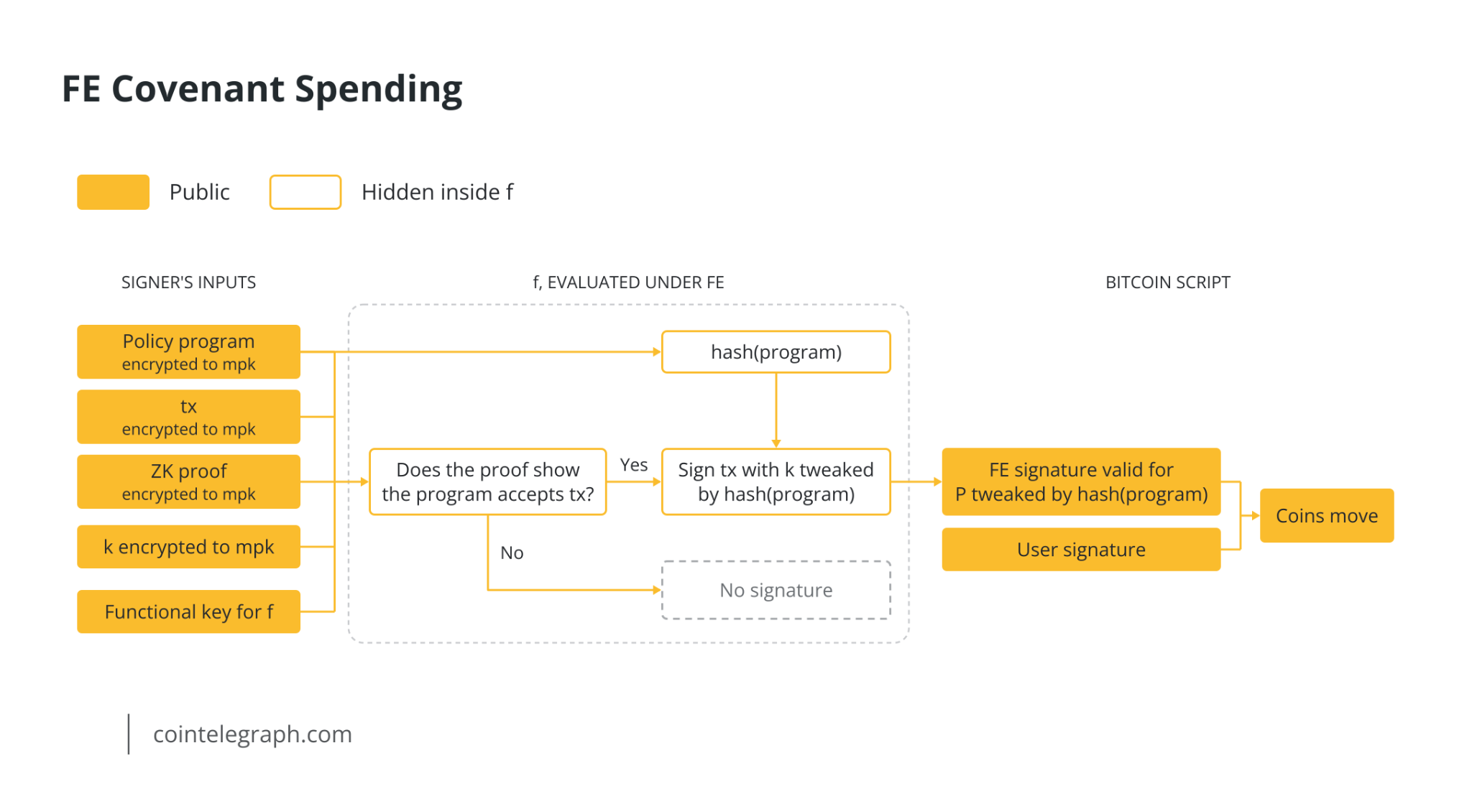
The general version of FE-based covenants with f(k, tx, program, proof) is strictly more expressive than OP_CTV. The general function proposed by Rubin takes a program that checks a condition on the transaction at spend time, and a zero-knowledge proof that the program accepts the transaction.

This zero-knowledge proof facilitates the implementation of the FE scheme, but does not add to it conceptually. A single fixed f works either way. Without the proof, f would have to be a general interpreter that runs any given program on tx itself. Such an f is large and costly to evaluate under FE. With the proof, f only has to verify a succinct proof. This could make it possible to enforce arbitrarily complex covenants without the need for more complexity in f. The proof also lets a spending policy depend on data outside the transaction, such as the result of an off-chain computation.

Why FE-based covenants remain infeasible for now

Goldwasser et al. (2014) introduced multi-input FE and built it on indistinguishability obfuscation. Multi-input FE and obfuscation are known to imply one another. Ananth and Jain (2015) showed that even single-input FE for general circuits yields obfuscation once it is made compact. The cryptographic primitive this design needs is therefore at least as hard to build as so-called indistinguishability obfuscation itself. Implementations of this principle remain at toy scale.

Carmer, Malozemoff and Raykova (2017) needed 3.7 hours to obfuscate a 12-bit pseudorandom function, a toy circuit of about 62,000 gates with a 64-bit key, far smaller than ECDSA signing on 256-bit numbers. The obfuscated program took 120 GB of disk space, and an evaluation ran for 67 minutes with 128 GB of RAM. The cost of implementing such a scheme would fall on whoever produces the signature, not on Bitcoin nodes. The authors called this “still far from practical.”

Furthermore, FE schemes that are practical cover only narrow function classes, such as the inner products of Abdalla et al. (2015), and the type of ECDSA signing required for Bitcoin covenants is not among them. Rubin’s paper concedes this point and lists under-developed cryptography and the setup trust assumption among its downsides. CTV-style opcodes remain far more efficient in bytes and verification, but require a base-layer change.

In our next article, we turn to Un-FE’d Covenants, which Rubin proposed to approximate covenant behavior without relying on impractical FE schemes. It replaces FE with oracle signers bonded through BitVM. [alloc]init’s Bitcoin PIPEs began in 2024 as an FE design and moved in 2026 to witness encryption. This proposal will also be covered in a follow-up article.




Source link

ShareTweetShareShare

Related Posts

Micron Technology (MU) Stock Pops 3% After SK Hynix Posts Record Quarter

Micron (MU) Stock Rises Premarket as Nvidia Memory Commitments Hit $390B

by J_News
November 18, 2026
0

TLDR Micron stock rose before the open Wednesday after Nvidia’s earnings beat. It is still down about 20% over the...

CoinStats Oct 16 to Nov 16 Updates: P/L and New Chains

CoinStats Oct 16 to Nov 16 Updates: P/L and New Chains

by J_News
November 18, 2026
0

Published November 16, 2026 · Last updated November 16, 2026 Three launches stand out this month: a switch that keeps...

Phoenix Signs and Apparel Announces New Phoenix Location – November 2026

Phoenix Signs and Apparel Announces New Phoenix Location – November 2026

by J_News
November 18, 2026
0

PHOENIX, AZ – Phoenix Signs & Apparel announces a new location coming November 2026 at 2122 W Lone Cactus Dr,...

Binance Hacker Moves Over $105 Million of Stolen Ethereum

Binance Hacker Moves Over $105 Million of Stolen Ethereum

by J_News
November 18, 2026
0

Binance attacker breaks silence Did he just sell?Just a week after Binance suffered the biggest cyberattack seen in the history of...

Goldman Sachs Boosted Its XRP ETF Stake to $144M, Then XRP Crashed

Goldman Sachs Boosted Its XRP ETF Stake to $144M, Then XRP Crashed

by J_News
November 18, 2026
0

Key TakeawaysGoldman’s XRP ETF position rose from $86.5 million in Q2 to over $144 million at Sept. 30.The bank spread...

Load More

Enter your email address:

Delivered by FeedBurner

Quick Navigate

  • Home
  • Crypto
  • Crypto Technical Analysis
  • Top News
  • Thank You
  • Store
  • About Us

Top News

Gram Price: Jumps 9% as Telegram Opens Money Wallet to More Users

Best Perp DEXes in 2026: Hyperliquid, Aster, Lighter, edgeX, and ApeX Omni Compared

Why Does Ethereum Gas Estimation Fail?

© 2021 mtrushmorecrypto - Crypto Related News Blog

We use cookies on our website to give you the most relevant experience by remembering your preferences and repeat visits. By clicking “Accept”, you consent to the use of ALL the cookies.
Do not sell my personal information.
Cookie SettingsAccept
Manage consent

Privacy Overview

This website uses cookies to improve your experience while you navigate through the website. Out of these, the cookies that are categorized as necessary are stored on your browser as they are essential for the working of basic functionalities of the website. We also use third-party cookies that help us analyze and understand how you use this website. These cookies will be stored in your browser only with your consent. You also have the option to opt-out of these cookies. But opting out of some of these cookies may affect your browsing experience.
Necessary
Always Enabled
Necessary cookies are absolutely essential for the website to function properly. These cookies ensure basic functionalities and security features of the website, anonymously.
CookieDurationDescription
cookielawinfo-checkbox-analytics11 monthsThis cookie is set by GDPR Cookie Consent plugin. The cookie is used to store the user consent for the cookies in the category "Analytics".
cookielawinfo-checkbox-functional11 monthsThe cookie is set by GDPR cookie consent to record the user consent for the cookies in the category "Functional".
cookielawinfo-checkbox-necessary11 monthsThis cookie is set by GDPR Cookie Consent plugin. The cookies is used to store the user consent for the cookies in the category "Necessary".
cookielawinfo-checkbox-others11 monthsThis cookie is set by GDPR Cookie Consent plugin. The cookie is used to store the user consent for the cookies in the category "Other.
cookielawinfo-checkbox-performance11 monthsThis cookie is set by GDPR Cookie Consent plugin. The cookie is used to store the user consent for the cookies in the category "Performance".
viewed_cookie_policy11 monthsThe cookie is set by the GDPR Cookie Consent plugin and is used to store whether or not user has consented to the use of cookies. It does not store any personal data.
Functional
Functional cookies help to perform certain functionalities like sharing the content of the website on social media platforms, collect feedbacks, and other third-party features.
Performance
Performance cookies are used to understand and analyze the key performance indexes of the website which helps in delivering a better user experience for the visitors.
Analytics
Analytical cookies are used to understand how visitors interact with the website. These cookies help provide information on metrics the number of visitors, bounce rate, traffic source, etc.
Advertisement
Advertisement cookies are used to provide visitors with relevant ads and marketing campaigns. These cookies track visitors across websites and collect information to provide customized ads.
Others
Other uncategorized cookies are those that are being analyzed and have not been classified into a category as yet.
SAVE & ACCEPT
No Result
View All Result
  • Home
  • Top News
  • Crypto
  • Crypto Technical Analysis
  • About Us

© 2021 mtrushmorecrypto - Crypto Related News Blog