

• Latest
  • Trending
How to Use sUSDS as Collateral in DeFi (Risks Included)

How to Use sUSDS as Collateral in DeFi (Risks Included)

August 11, 2026
Plug Power (PLUG) Stock: Surges on 125% GenDrive Growth and Stronger Hydrogen Sales

Plug Power (PLUG) Stock: Surges on 125% GenDrive Growth and Stronger Hydrogen Sales

August 11, 2026
We’re raising BTC/USD margin leverage to 20x on Kraken Pro

We’re raising BTC/USD margin leverage to 20x on Kraken Pro

August 11, 2026
CFTC orders Kalshi to continue offering prediction markets in New York after state lawsuit

CFTC orders Kalshi to continue offering prediction markets in New York after state lawsuit

August 11, 2026
Nvidia Taps Blackrock, Goldman Sachs, Blackstone to Mobilize $500B for AI

Nvidia Taps Blackrock, Goldman Sachs, Blackstone to Mobilize $500B for AI

August 11, 2026
SharpLink Reports $394M Q2 Loss As Ethereum Revaluation Hits Results

SharpLink Reports $394M Q2 Loss As Ethereum Revaluation Hits Results

August 11, 2026
Beyond Meat (BYND) Stock Sinks 21% as Nasdaq Reverse Split Nears

Beyond Meat (BYND) Stock Sinks 21% as Nasdaq Reverse Split Nears

August 11, 2026
Strategy Remains Committed to Bitcoin Buys Despite Recent BTC Sales, CEO Says

Strategy Remains Committed to Bitcoin Buys Despite Recent BTC Sales, CEO Says

August 11, 2026
Unusual Bitcoin On-Chain Activity: Four Post-Satoshi Era Wallets Awaken With 8,000% Gains After 12 Years

Unusual Bitcoin On-Chain Activity: Four Post-Satoshi Era Wallets Awaken With 8,000% Gains After 12 Years

August 11, 2026
Stellar price risks a deeper correction toward $0.142

Stellar price risks a deeper correction toward $0.142

August 11, 2026
  • Privacy Policy
Tuesday, August 11, 2026
MtRushmoreCrypto - Where Crypto Rocks
  • Home
  • Top News
  • Crypto
  • Crypto Technical Analysis
  • About Us
No Result
View All Result
  • Home
  • Top News
  • Crypto
  • Crypto Technical Analysis
  • About Us
No Result
View All Result
Logo
No Result
View All Result
Home Crypto Technical Analysis

How to Use sUSDS as Collateral in DeFi (Risks Included)

J_News by J_News
August 11, 2026
in Crypto Technical Analysis, Top News
0
How to Use sUSDS as Collateral in DeFi (Risks Included)
0
SHARES
0
VIEWS
Share on FacebookShare on Twitter


Hero image. Title card: “How to Use sUSDS as Collateral in DeFi. Composability with a catch: real liquidation risk.”

sUSDS can be posted as collateral to borrow against, and in markets that support it, keep earning the Sky Savings Rate while it does. That is the appeal. Liquidation is the catch, so this is an advanced move, not the simple way to use sUSDS.

Related articles

Plug Power (PLUG) Stock: Surges on 125% GenDrive Growth and Stronger Hydrogen Sales

Plug Power (PLUG) Stock: Surges on 125% GenDrive Growth and Stronger Hydrogen Sales

August 11, 2026
We’re raising BTC/USD margin leverage to 20x on Kraken Pro

We’re raising BTC/USD margin leverage to 20x on Kraken Pro

August 11, 2026

Here is the honest version up front. You can use sUSDS as collateral in DeFi money markets to borrow against, and because it can keep accruing the Sky Savings Rate (SSR) while posted, your collateral can stay productive instead of sitting idle. Borrowing against collateral also means you can be liquidated, so this is an advanced activity, not the default way to hold sUSDS.

If your goal is simply to save, you do not need any of this. You can hold sUSDS and let it earn. This guide is for experienced DeFi users who understand leverage and want liquidity without selling their position.

sUSDS is the yield-generating form of USDS, and the Sky Savings Rate is the governance-set yield it accrues. That detail matters here, because the whole reason to post sUSDS rather than a plain dollar is that, in supporting markets, it can keep earning while it works as collateral.

Borrowing against sUSDS carries liquidation risk. Simply holding it does not.
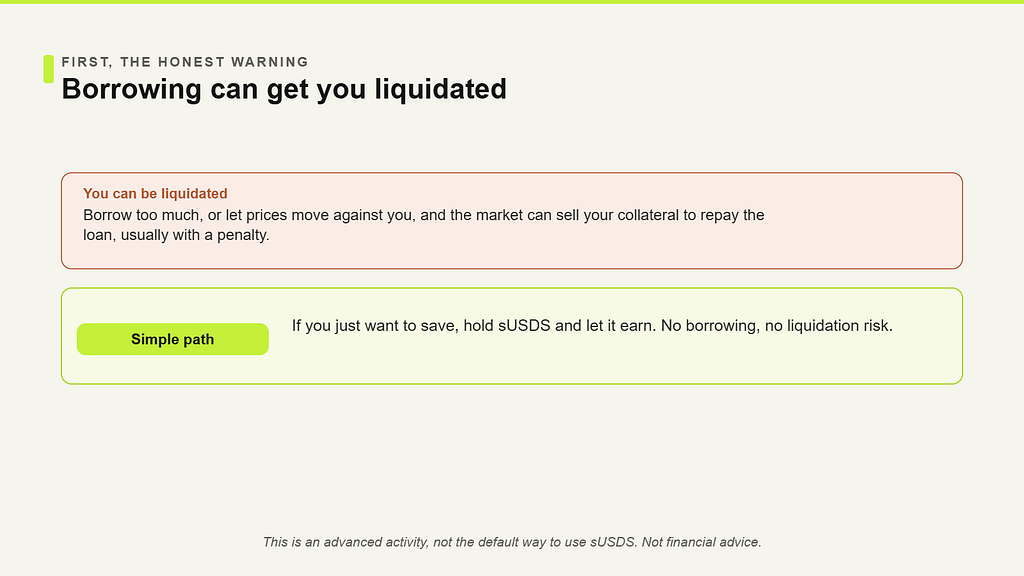
The honest warning: borrowing can get you liquidated; the simple path is to hold sUSDS. Alt text: liquidation risk warning for using sUSDS as collateral.

First, the honest warning

Borrowing against collateral means you can be liquidated. If you borrow too much, or the price of what you borrowed rises, or your collateral value falls, the market can sell your collateral to repay the loan, usually with a penalty. That is a real loss, and it is the defining risk of this activity.

Do not assume the position is safe just because sUSDS is a stable collateral. You are borrowing another asset against it, and that asset can move. A stable collateral lowers one variable, it does not remove liquidation risk. This article is educational and is not financial advice.

What does using sUSDS as collateral mean?

Using sUSDS as collateral means supplying it into a DeFi money market and borrowing another asset against it. You still own the sUSDS. It is locked as collateral until you repay what you borrowed, at which point you can withdraw it. This is possible because sUSDS is composable, a standard onchain token that other DeFi protocols can accept.

The loop is straightforward: post collateral, borrow against it, repay to release it. The complexity lives entirely in managing the gap between what you posted and what you owe.

Why use sUSDS as collateral?

The appeal is liquidity without selling, plus productive collateral. You can borrow against your sUSDS instead of redeeming or selling it, so you keep your position and any exposure you wanted to hold. That is useful if you need cash for something else but do not want to exit.

The differentiated part is that, in markets that support it, your sUSDS can keep accruing the Sky Savings Rate while it sits as collateral, so it is not idle capital. That is what composability makes possible, and you should verify it market by market before relying on it. Every one of these benefits comes attached to liquidation risk, and the two travel together.

In supporting markets, sUSDS can keep earning the Sky Savings Rate while posted as collateral.
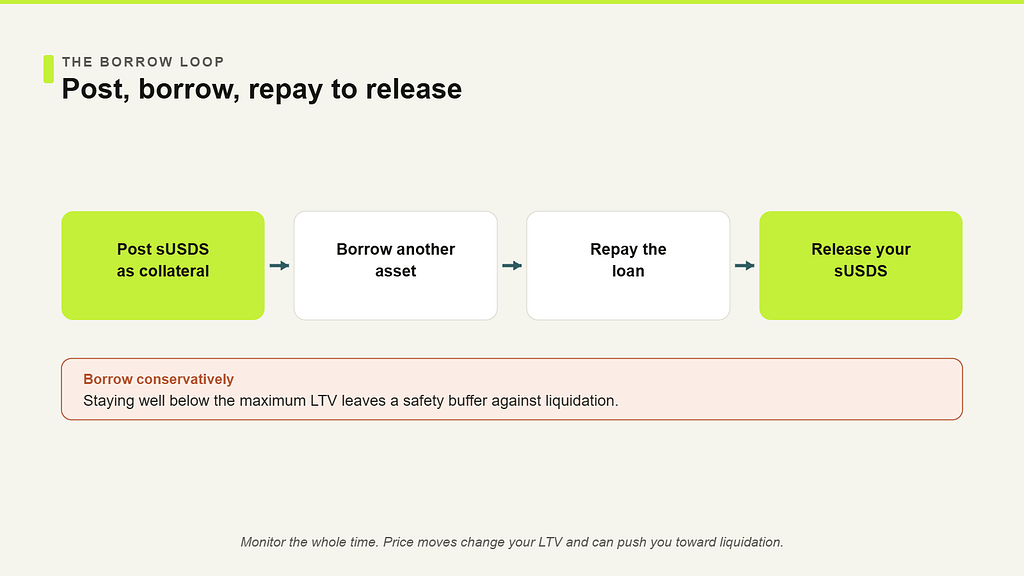
The borrow loop: post sUSDS, borrow, repay, release, with a note to borrow conservatively. Alt text: how to borrow against sUSDS step by step.

How LTV and liquidation work

Loan-to-value, or LTV, is your borrowed amount divided by your collateral value, and it is the number that decides whether you are safe. Each market sets a maximum LTV and a liquidation threshold. If your LTV climbs past that threshold, because you borrowed too much, the borrowed asset rose in price, or your collateral value fell, your collateral is liquidated to repay the loan, often with a penalty.

The mechanics are worth knowing in plain terms before you borrow anything:

  • Collateral. The assets you post to borrow against, here your sUSDS.
  • LTV (loan-to-value). Your borrowed amount divided by your collateral value.
  • Liquidation threshold. The LTV level at which your position can be liquidated.
  • Liquidation. Your collateral is sold to repay the loan, often with a penalty.
  • Health factor. A market’s measure of how close your position sits to liquidation.

Specific maximum-LTV and threshold numbers are set by each market and change, so read them live rather than trusting a figure in any article, including this one.
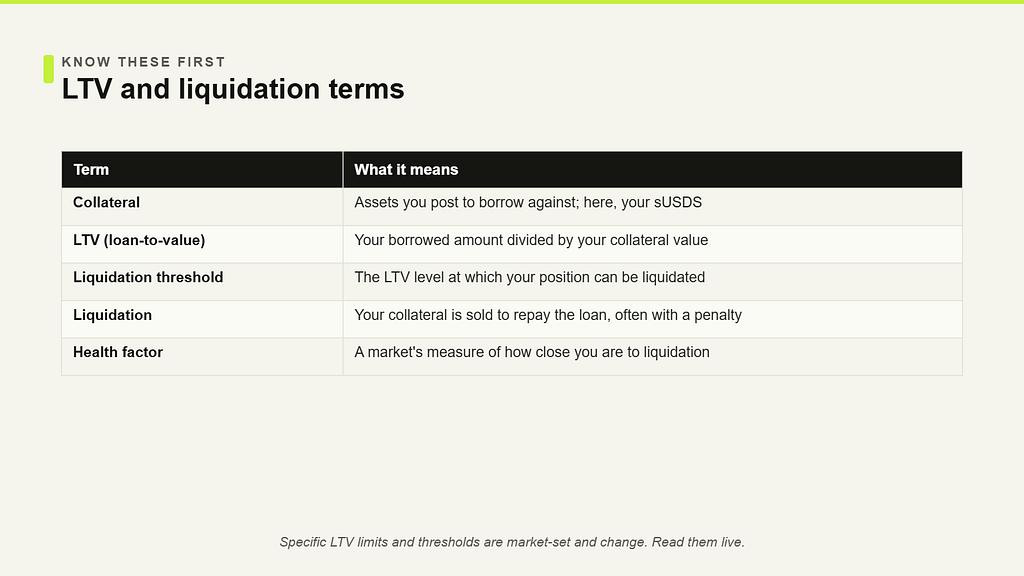
Glossary of LTV and liquidation terms. Alt text: what is LTV, liquidation threshold, liquidation, and health factor.

How to use sUSDS as collateral, step by step

Treat every step as reversible and monitor the whole time. This is the opposite of set-and-forget.

  1. Choose a DeFi money market that accepts sUSDS as collateral, such as Spark within the Sky ecosystem, and verify current listings and parameters in the live app.
  2. Supply your sUSDS as collateral in that market.
  3. Borrow another asset against it, staying well below the maximum LTV to leave a safety buffer. This is the step where liquidation risk begins.
  4. Monitor your position, because price moves change your LTV and can push you toward liquidation.
  5. Repay what you borrowed to release and withdraw your sUSDS.

I would not name a specific market’s parameters here, because they are market-set and shift.

Confirm which venues accept sUSDS, the current limits, and whether yield accrues while posted, before you commit.
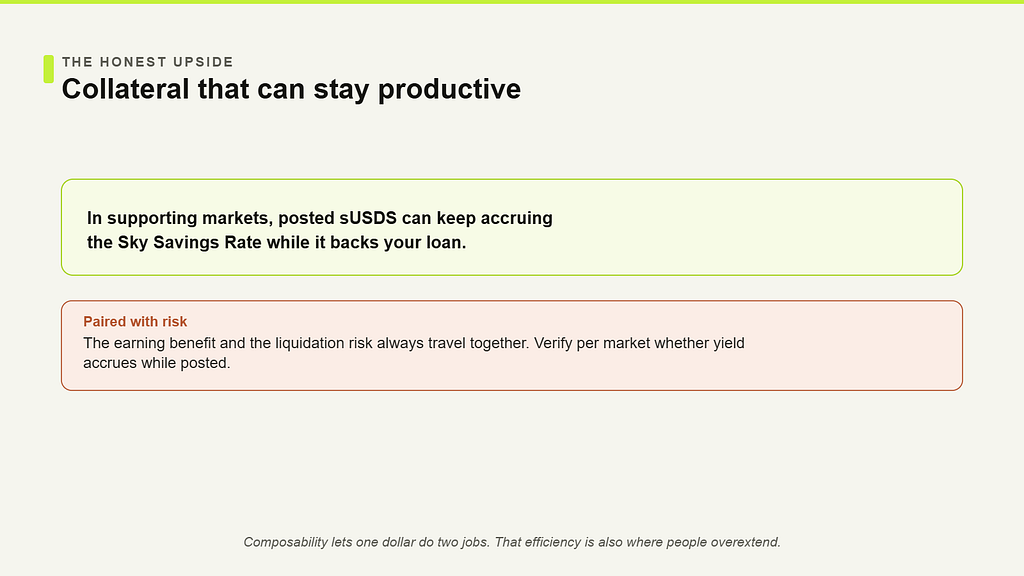
The honest upside: posted sUSDS can stay productive, always paired with liquidation risk. Alt text: sUSDS can keep earning the Sky Savings Rate while used as collateral, with risk.

Managing the risk

Safety in this activity is mostly about restraint and attention. Borrow conservatively and keep a large buffer below the maximum LTV, so an ordinary price move does not put you near the threshold. Monitor actively, because a position that was safe last week can drift.

Know your market’s liquidation threshold and penalty before you borrow, remember that borrowing a volatile asset raises the risk, and have a plan to add collateral or repay if your position moves the wrong way. None of this is financial advice, and no buffer makes liquidation impossible.

Is this right for you?

Using sUSDS as collateral suits experienced DeFi users who understand liquidation and want liquidity without selling their position. If your goal is simply to save, you do not need this. You can hold sUSDS and let it earn the Sky Savings Rate, with no borrowing and no liquidation risk at all.

The right choice depends on your experience and your risk tolerance. If you are unsure, that uncertainty is itself an answer: stay with the simple path.
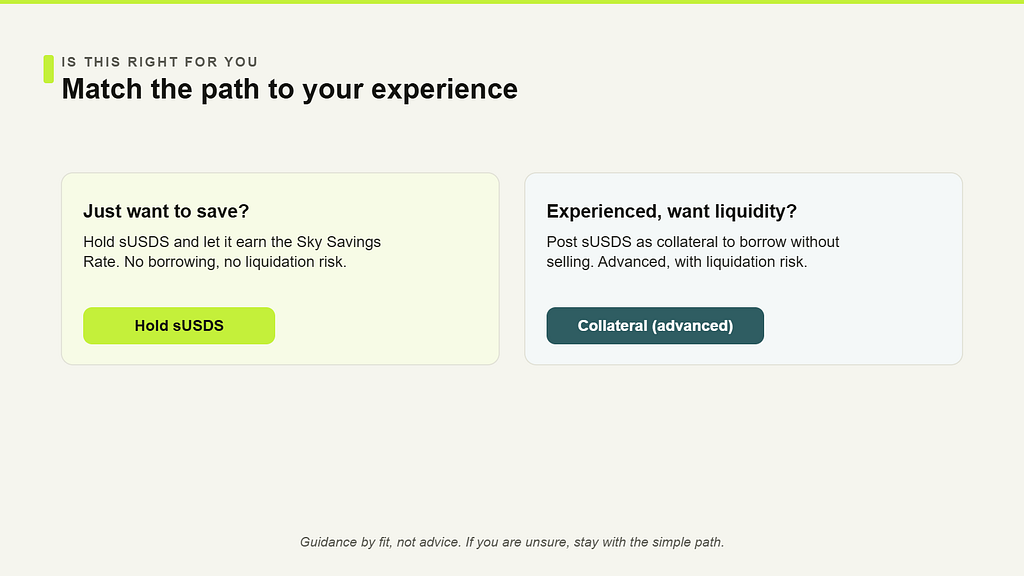
Decision guide: just want to save, hold sUSDS; experienced and want liquidity, collateral is an advanced path. Alt text: should you use sUSDS as collateral, matched to experience.

A final thought

The genuinely interesting thing about sUSDS as collateral is that it lets one dollar do two jobs, earning the Sky Savings Rate while backing a loan. That is a real efficiency, and it is also exactly where people overextend, because a productive position can lull you into borrowing more than you should.

If you want the efficiency, borrow far below the limit and watch the position like it is a job, because for the duration of the loan, it is. If you just want your dollars to grow quietly, the set-and-forget path of simply holding sUSDS is right there, and it carries none of this. Verify current market parameters at the source before you post anything.

Have you used a stablecoin as collateral, and how did you set your buffer? I would like to read your approach in the responses.

Frequently asked questions

Can you use sUSDS as collateral?

Yes. sUSDS is composable and can be supplied as collateral in DeFi money markets that accept it, to borrow other assets against. You keep ownership until you repay and withdraw.

Where can I use sUSDS as collateral?

In DeFi money markets that list it, such as Spark within the Sky ecosystem. Verify current venues, limits, and whether yield accrues while posted in the live app before committing.

Does sUSDS keep earning while used as collateral?

In markets that support it, yes, it can keep accruing the Sky Savings Rate while posted. This varies by market, so confirm it for the specific venue rather than assuming.

What is LTV?

Loan-to-value is your borrowed amount divided by your collateral value. Each market sets a maximum LTV and a liquidation threshold, and crossing the threshold triggers liquidation.

Can I be liquidated with a stable collateral?

Yes. Borrowing a volatile asset, or borrowing too much, can still push your LTV past the liquidation threshold even when your collateral is a stable coin like sUSDS.

Do I have to use sUSDS as collateral?

No. If you just want to save, simply hold sUSDS and let it earn. Using it as collateral is an advanced, optional activity for people who understand the risk.


How to Use sUSDS as Collateral in DeFi (Risks Included) was originally published in The Capital on Medium, where people are continuing the conversation by highlighting and responding to this story.


Source link

ShareTweetShareShare

Related Posts

Plug Power (PLUG) Stock: Surges on 125% GenDrive Growth and Stronger Hydrogen Sales

Plug Power (PLUG) Stock: Surges on 125% GenDrive Growth and Stronger Hydrogen Sales

by J_News
August 11, 2026
0

TLDR Plug Power stock rises as GenDrive deployments surge 125% year over year in Q2. Hydrogen fuel revenue climbs 15%...

We’re raising BTC/USD margin leverage to 20x on Kraken Pro

We’re raising BTC/USD margin leverage to 20x on Kraken Pro

by J_News
August 11, 2026
0

TL;DR 20x leverage is now available on BTC/USD margin for eligible traders on Kraken Pro. Liquidation price, margin ratio, and...

CFTC orders Kalshi to continue offering prediction markets in New York after state lawsuit

CFTC orders Kalshi to continue offering prediction markets in New York after state lawsuit

by J_News
August 11, 2026
0

"New York intends to make event contract derivatives waste away under its iron curtain of state gaming laws before the...

Nvidia Taps Blackrock, Goldman Sachs, Blackstone to Mobilize $500B for AI

Nvidia Taps Blackrock, Goldman Sachs, Blackstone to Mobilize $500B for AI

by J_News
August 11, 2026
0

Key TakeawaysNvidia and six financial firms target more than $500 billion for AI.Financial partners, not Nvidia, decide which projects receive...

SharpLink Reports $394M Q2 Loss As Ethereum Revaluation Hits Results

SharpLink Reports $394M Q2 Loss As Ethereum Revaluation Hits Results

by J_News
August 11, 2026
0

SharpLink reported a $394.3 million net loss for the second quarter of 2026, with the result driven largely by non-cash...

Load More

Enter your email address:

Delivered by FeedBurner

Quick Navigate

  • Home
  • Crypto
  • Crypto Technical Analysis
  • Top News
  • Thank You
  • Store
  • About Us

Top News

DOGE slides below $0.070 as market sentiment weakens

8,000 Devices Infected, 80 Crypto Wallets Accessed by Video Game Malware

Crypto Advocacy Groups Support CLARITY Passage as Ethics Rules Face Pushback

© 2021 mtrushmorecrypto - Crypto Related News Blog

We use cookies on our website to give you the most relevant experience by remembering your preferences and repeat visits. By clicking “Accept”, you consent to the use of ALL the cookies.
Do not sell my personal information.
Cookie SettingsAccept
Manage consent

Privacy Overview

This website uses cookies to improve your experience while you navigate through the website. Out of these, the cookies that are categorized as necessary are stored on your browser as they are essential for the working of basic functionalities of the website. We also use third-party cookies that help us analyze and understand how you use this website. These cookies will be stored in your browser only with your consent. You also have the option to opt-out of these cookies. But opting out of some of these cookies may affect your browsing experience.
Necessary
Always Enabled
Necessary cookies are absolutely essential for the website to function properly. These cookies ensure basic functionalities and security features of the website, anonymously.
CookieDurationDescription
cookielawinfo-checkbox-analytics11 monthsThis cookie is set by GDPR Cookie Consent plugin. The cookie is used to store the user consent for the cookies in the category "Analytics".
cookielawinfo-checkbox-functional11 monthsThe cookie is set by GDPR cookie consent to record the user consent for the cookies in the category "Functional".
cookielawinfo-checkbox-necessary11 monthsThis cookie is set by GDPR Cookie Consent plugin. The cookies is used to store the user consent for the cookies in the category "Necessary".
cookielawinfo-checkbox-others11 monthsThis cookie is set by GDPR Cookie Consent plugin. The cookie is used to store the user consent for the cookies in the category "Other.
cookielawinfo-checkbox-performance11 monthsThis cookie is set by GDPR Cookie Consent plugin. The cookie is used to store the user consent for the cookies in the category "Performance".
viewed_cookie_policy11 monthsThe cookie is set by the GDPR Cookie Consent plugin and is used to store whether or not user has consented to the use of cookies. It does not store any personal data.
Functional
Functional cookies help to perform certain functionalities like sharing the content of the website on social media platforms, collect feedbacks, and other third-party features.
Performance
Performance cookies are used to understand and analyze the key performance indexes of the website which helps in delivering a better user experience for the visitors.
Analytics
Analytical cookies are used to understand how visitors interact with the website. These cookies help provide information on metrics the number of visitors, bounce rate, traffic source, etc.
Advertisement
Advertisement cookies are used to provide visitors with relevant ads and marketing campaigns. These cookies track visitors across websites and collect information to provide customized ads.
Others
Other uncategorized cookies are those that are being analyzed and have not been classified into a category as yet.
SAVE & ACCEPT
No Result
View All Result
  • Home
  • Top News
  • Crypto
  • Crypto Technical Analysis
  • About Us

© 2021 mtrushmorecrypto - Crypto Related News Blog