• Latest
  • Trending
On-Chain Perpetuals: The Difference Between Virtual Liquidity and Real Capital

On-Chain Perpetuals: The Difference Between Virtual Liquidity and Real Capital

November 3, 2026
SpaceX Blocks OKX-ICE Tokenized Stocks Despite Offshore Tokens

SpaceX Blocks OKX-ICE Tokenized Stocks Despite Offshore Tokens

November 3, 2026
Consensys Unveils Bridgeless Transaction Network for Institutions

Consensys Unveils Bridgeless Transaction Network for Institutions

November 3, 2026
Ripple CEO Brad Garlinghouse Breaks Silence on XRP vs. RLUSD Debate

Ripple CEO Brad Garlinghouse Breaks Silence on XRP vs. RLUSD Debate

November 3, 2026
Coinbase Launches AI Agent Sign-Ups for Crypto Trading With Built-In Safety Limits

Coinbase Launches AI Agent Sign-Ups for Crypto Trading With Built-In Safety Limits

November 3, 2026
Binance Publishes New Proof-of-Reserves Snapshot Following October Attack

Binance Publishes New Proof-of-Reserves Snapshot Following October Attack

November 3, 2026
ARK Invest Buys Coinbase, Circle and Robinhood Shares

ARK Invest Buys Coinbase, Circle and Robinhood Shares

November 3, 2026
Wall Street Ended Bitcoin’s Wild Rallies, Says Markus Thielen

Wall Street Ended Bitcoin’s Wild Rallies, Says Markus Thielen

November 3, 2026
99% Cold Wallet Rule Mulled by South Korea Following Binance Hack

99% Cold Wallet Rule Mulled by South Korea Following Binance Hack

November 3, 2026
Spotting Fat Tails and Skewness in Market Returns with Seaborn Histograms and KDE Curves

Spotting Fat Tails and Skewness in Market Returns with Seaborn Histograms and KDE Curves

November 3, 2026
  • Privacy Policy
Tuesday, November 3, 2026
MtRushmoreCrypto - Where Crypto Rocks
  • Home
  • Top News
  • Crypto
  • Crypto Technical Analysis
  • About Us
No Result
View All Result
  • Home
  • Top News
  • Crypto
  • Crypto Technical Analysis
  • About Us
No Result
View All Result
Logo
No Result
View All Result
Home Crypto Technical Analysis

On-Chain Perpetuals: The Difference Between Virtual Liquidity and Real Capital

J_News by J_News
November 3, 2026
in Crypto Technical Analysis, Top News
0
On-Chain Perpetuals: The Difference Between Virtual Liquidity and Real Capital
0
SHARES
1
VIEWS
Share on FacebookShare on Twitter


A constructed ETH perpetual, used to separate position size, execution price, and loss-absorbing capital.

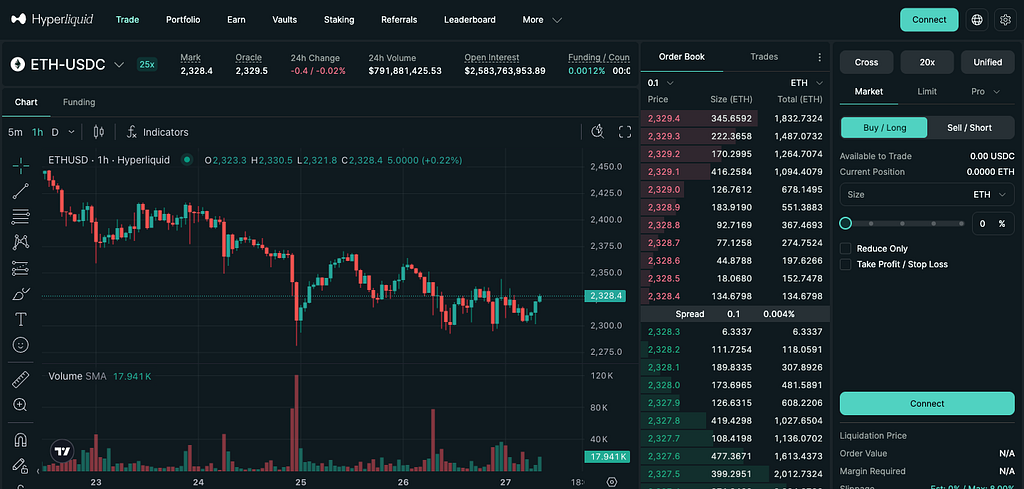
Overview. Hyperliquid’s ETH-USDC trading interface, captured on 27 October 2026 without a connected wallet. The order book and order-entry panel motivate the distinctions below; all numerical examples use a separate, constructed $2,000 ETH perpetual.

A perpetual exchange can show deep liquidity and low slippage. Neither number says how much capital can absorb losses when traders move in the same direction: the mechanism that prices a trade is not necessarily the balance sheet that stands behind it.

Related articles

SpaceX Blocks OKX-ICE Tokenized Stocks Despite Offshore Tokens

SpaceX Blocks OKX-ICE Tokenized Stocks Despite Offshore Tokens

November 3, 2026
Consensys Unveils Bridgeless Transaction Network for Institutions

Consensys Unveils Bridgeless Transaction Network for Institutions

November 3, 2026

On the Hyperliquid page above, the panel on the right asks for margin mode, leverage, side, and size. It provides fields for order value, required margin, liquidation price, and slippage; in this disconnected view, the order-specific estimates are not populated. The order book in the middle is what a market order will walk through.

Suppose a 5 ETH long fills at $2,000. Its entry notional is $10,000; in this fee-less example, $2,000 of margin corresponds to 5× entry leverage. If the mark later reaches $2,200, its price-move PnL is $1,000, whether the margin is $2,000 or $5,000. The fill price depends on how the venue prices the trade, which the panel only estimates as slippage. Nothing on the panel says whose balance sheet pays the $1,000. The numbers below are classroom identities, not exchange prints.

A position without owning the asset

A linear USDC-margined perpetual pays the move on signed quantity qq, measured in ETH:

For a long, q > 0; for a short, the sign reverses. With q = 5 ETH, entry P₀ = $2,000, and mark Pₜ = $2,200, the long gains $1,000 and the short loses $1,000. Entry notional is $10,000.

Leverage is entry notional divided by posted collateral C:

Hold size fixed and the 5 ETH position is 2× with $5,000 posted and 5× with $2,000 posted: dollar PnL stays $1,000 while the return on margin moves from 20% to 50%. Hold collateral fixed at $2,000 instead and the 2× and 5× longs are 2 ETH and 5 ETH, gaining $400 and $1,000. The formula starts at P₀; how the trade reached P₀ is the next question.

Fig. 1. Constructed USDC examples. With 5 ETH fixed, changing collateral changes return on margin, not dollar PnL. With $2,000 fixed, moving from 2 ETH to 5 ETH changes both. All positions are marked at $2,200.

Three ways to price the same trade

I send the same fee-less buy through three constructed rules, each starting from a $2,000 reference. Venue type and pricing rule are separate choices: a CEX or a DEX can run a central limit order book (CLOB) or an AMM-style curve.

CLOB

The ask ladder offers 10 ETH at $2,000, another 10 at $2,020, then 10 at $2,060. The fill is the volume-weighted average

A 10 ETH buy fills at $2,000. A 20 ETH buy averages $2,010; its last unit trades at $2,020 and the next ask is $2,060. Beyond 30 ETH this book shows nothing.

Virtual AMM (vAMM)

Archived Perpetual Protocol v1 documentation describes virtual reserves as pricing state, with collateral held in a separate vault. Here x = 1,000 virtual ETH and y = 2,000,000 virtual USDC satisfy xy = k, a $2,000 marginal quote. A buy pays

At 20 ETH the average is $2,040.82 and the ending marginal quote $2,082.47. No ETH or USDC sits behind x and y; collateral, PnL, and settlement have to live somewhere else.

Imbalance-based pricing rule

This is a minimal model, not a description of GMX, Hyperliquid, dYdX, or any other venue, where index and mark prices, funding, and risk parameters also enter. Let D = OIₗ − OIₛ be net trader imbalance in ETH and set the marginal price to

With u the ETH added to imbalance, a buy from D = 0 to D = q averages

so a 20 ETH buy from a flat book averages $2,020 and ends at $2,040. The slope of 2 is chosen for readability.

At 10 ETH the three averages are $2,000, $2,020.20, and $2,010; at 20 ETH, $2,010, $2,040.82, and $2,020. The ranking is an artifact of the chosen ladder, virtual depth, and slope. What carries over to live venues is the state each rule moves: the CLOB exhausts posted levels, the vAMM shifts virtual reserves, and the imbalance rule moves with signed net trader imbalance.

Fig. 2. Fee-less classroom rules, in USDC per ETH. The zero-size $2,000 quote is a limit, not a realized average. The vAMM’s ending marginal quote sits above its average; the imbalance line is a minimal model, not a venue formula.

Virtual liquidity is not real capital

A quote does not say who pays a trader’s gain. Consider a hypothetical pool that takes the other side of trader positions. After aggregating them, assume the pool is short 40 ETH and has no offsetting hedge or external risk transfer. This is not a claim about every perp DEX: a CLOB has resting orders on the other side, and a vault that only holds trader margin is different again.

An external $250 rise from $2,000 to $2,250 marks the pool at

Raise virtual reserves from 200 to 2,000 ETH and a 10 ETH probe’s average impact falls from about $105.26 to $10.05 per ETH. The mark stays −$10,000: depth changed the quote, not the inventory. The probe and the shock are independent comparisons.

The −$10,000 is a change in the pool’s marked equity, not necessarily an immediate cash payment. In this simplified example, starting equity of $50,000 falls to $40,000; starting equity of $12,000 falls to $2,000.

A hedge would change the pool’s net exposure. Insurance or other backstops would require a separate account of who can access those resources and under what conditions. Neither is represented by the virtual reserves used to quote the trade.

Fig. 3. Independent counterfactuals for a hypothetical unhedged pool. A 10 ETH probe tests virtual depth at a fixed $2,000 reference; a separate +$250 shock marks the pool short 40 ETH at −$10,000. $50,000 and $12,000 are alternative starting-equity assumptions, falling to $40,000 and $2,000.

Closing

Execution depth, net exposure, and loss-absorbing resources answer different questions. Holding net exposure and the external shock fixed, more virtual depth changes the quote but not the existing position’s mark-to-market loss. This is a static comparison: over time, deeper quotes can change trading demand, position build-up, and liquidations, and with them the exposure itself.

Appendix

  • Model. One fee-less, constructed ETH perpetual at $2,000. The figures exclude funding, insurance, hedging, and liquidation.
  • Position. PnL = q (Pₜ − P₀); L = |q| P₀ / C.
  • Execution. CLOB asks are 10 ETH at $2,000, $2,020, and $2,060. The vAMM uses x = 1,000, y = 2,000,000. The imbalance rule 2,000 + 2D is a minimal model, not a production formula.
  • Pool mark. Traders are net long 40 ETH; a separate +$250 shock gives the unhedged pool a −$10,000 mark. Starting equity of $50,000 or $12,000 falls to $40,000 or $2,000.
  • Sources. Perpetual Protocol v1 vAMM (archived); GMX order types and fees.
  • Related. TVL, Marginal Price, and Liquidity in an AMM. Why High Volume/TVL Doesn’t Guarantee a Good Swap Price.

This post was originally published on my personal blog: https://egpivo.dev/articles/on-chain-perpetuals-virtual-liquidity-and-real-capital.


On-Chain Perpetuals: The Difference Between Virtual Liquidity and Real Capital was originally published in The Capital on Medium, where people are continuing the conversation by highlighting and responding to this story.




Source link

ShareTweetShareShare

Related Posts

SpaceX Blocks OKX-ICE Tokenized Stocks Despite Offshore Tokens

SpaceX Blocks OKX-ICE Tokenized Stocks Despite Offshore Tokens

by J_News
November 3, 2026
0

Just months after tokenized versions of SpaceX shares became one of the biggest drivers of onchain stock trading, the aerospace...

Consensys Unveils Bridgeless Transaction Network for Institutions

Consensys Unveils Bridgeless Transaction Network for Institutions

by J_News
November 3, 2026
0

TLDR Consensys launched Sovereign Network Interoperability on November 2, 2026, at Devcon in Mumbai. The software allows banks to settle...

Ripple CEO Brad Garlinghouse Breaks Silence on XRP vs. RLUSD Debate

Ripple CEO Brad Garlinghouse Breaks Silence on XRP vs. RLUSD Debate

by J_News
November 3, 2026
0

XRP vs. RLUSD differencesBrad Garlinghouse recently vowed never to leave XRP behindRipple CEO Brad Garlinghouse addressed the ongoing debate over...

Coinbase Launches AI Agent Sign-Ups for Crypto Trading With Built-In Safety Limits

Coinbase Launches AI Agent Sign-Ups for Crypto Trading With Built-In Safety Limits

by J_News
November 3, 2026
0

Key Takeaways:Coinbase has created a special page for AI agents to sign up.Actively search and trade crypto under AI tools...

Binance Publishes New Proof-of-Reserves Snapshot Following October Attack

Binance Publishes New Proof-of-Reserves Snapshot Following October Attack

by J_News
November 3, 2026
0

TL;DR: Binance said on November 2 that it had completed a zero-knowledge proof-of-reserves procedure for a snapshot taken October 31,...

Load More

Enter your email address:

Delivered by FeedBurner

Quick Navigate

  • Home
  • Crypto
  • Crypto Technical Analysis
  • Top News
  • Thank You
  • Store
  • About Us

Top News

Gram Price: Jumps 9% as Telegram Opens Money Wallet to More Users

Fortinet (FTNT) Stock Hits All-Time High as Billings Surge 33%

Arc Launches Agentic Payments with USDC Across 3 Chains, Removing Gas Wallet Hassles

© 2021 mtrushmorecrypto - Crypto Related News Blog

We use cookies on our website to give you the most relevant experience by remembering your preferences and repeat visits. By clicking “Accept”, you consent to the use of ALL the cookies.
Do not sell my personal information.
Cookie SettingsAccept
Manage consent

Privacy Overview

This website uses cookies to improve your experience while you navigate through the website. Out of these, the cookies that are categorized as necessary are stored on your browser as they are essential for the working of basic functionalities of the website. We also use third-party cookies that help us analyze and understand how you use this website. These cookies will be stored in your browser only with your consent. You also have the option to opt-out of these cookies. But opting out of some of these cookies may affect your browsing experience.
Necessary
Always Enabled
Necessary cookies are absolutely essential for the website to function properly. These cookies ensure basic functionalities and security features of the website, anonymously.
CookieDurationDescription
cookielawinfo-checkbox-analytics11 monthsThis cookie is set by GDPR Cookie Consent plugin. The cookie is used to store the user consent for the cookies in the category "Analytics".
cookielawinfo-checkbox-functional11 monthsThe cookie is set by GDPR cookie consent to record the user consent for the cookies in the category "Functional".
cookielawinfo-checkbox-necessary11 monthsThis cookie is set by GDPR Cookie Consent plugin. The cookies is used to store the user consent for the cookies in the category "Necessary".
cookielawinfo-checkbox-others11 monthsThis cookie is set by GDPR Cookie Consent plugin. The cookie is used to store the user consent for the cookies in the category "Other.
cookielawinfo-checkbox-performance11 monthsThis cookie is set by GDPR Cookie Consent plugin. The cookie is used to store the user consent for the cookies in the category "Performance".
viewed_cookie_policy11 monthsThe cookie is set by the GDPR Cookie Consent plugin and is used to store whether or not user has consented to the use of cookies. It does not store any personal data.
Functional
Functional cookies help to perform certain functionalities like sharing the content of the website on social media platforms, collect feedbacks, and other third-party features.
Performance
Performance cookies are used to understand and analyze the key performance indexes of the website which helps in delivering a better user experience for the visitors.
Analytics
Analytical cookies are used to understand how visitors interact with the website. These cookies help provide information on metrics the number of visitors, bounce rate, traffic source, etc.
Advertisement
Advertisement cookies are used to provide visitors with relevant ads and marketing campaigns. These cookies track visitors across websites and collect information to provide customized ads.
Others
Other uncategorized cookies are those that are being analyzed and have not been classified into a category as yet.
SAVE & ACCEPT
No Result
View All Result
  • Home
  • Top News
  • Crypto
  • Crypto Technical Analysis
  • About Us

© 2021 mtrushmorecrypto - Crypto Related News Blog