


TLDR
- The S&P 500 fell 0.2% Friday but still posted its third straight weekly gain, up 0.4% for the week
- The index hit an all-time intraday high of 7,816.70 on Thursday before pulling back
- The VIX fell as low as 14.28, one of its lowest readings since 1990
- Retail sales dropped unexpectedly in July and consumer confidence fell in August
- Markets now price in a two-thirds chance the Fed holds rates steady in September
The S&P 500 closed down 0.2% on Friday at 7,785.76, one day after hitting a new all-time intraday high of 7,816.70. The Dow Jones Industrial Average dropped 107 points, or 0.2%, to 53,732.41. The Nasdaq Composite slipped 0.3% to 26,729.16.
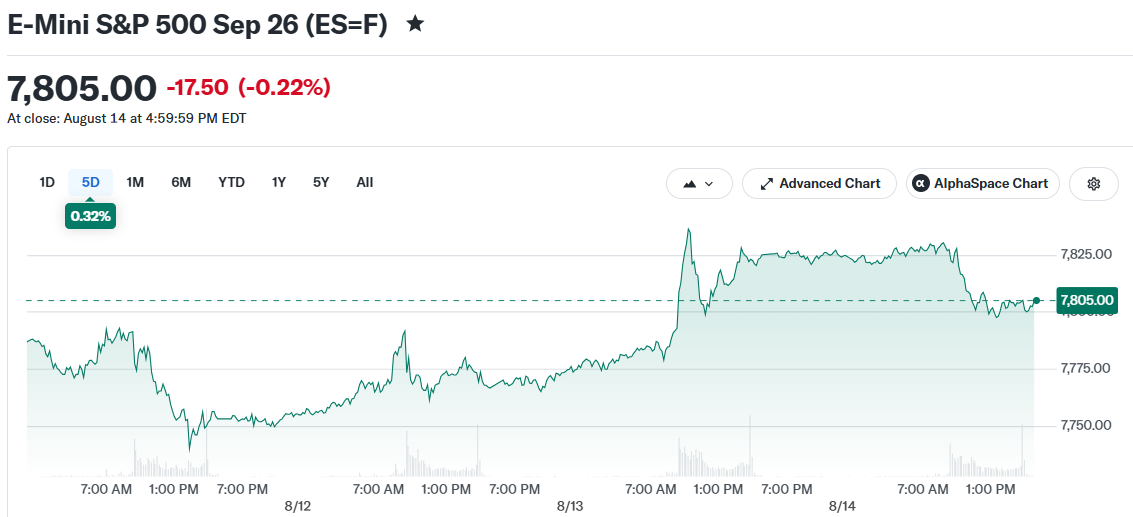
Despite Friday’s dip, the S&P 500 still ended the week up 0.4%. That marks three straight weeks of gains for the index. The Nasdaq also closed the week higher by 0.1%, while the Dow finished the week down 0.6%.
The market’s fear gauge, the CBOE Volatility Index, dropped as low as 14.28 on Friday. That level is historically low. Going back to 1990, the VIX has only been below 15 around 32% of the time, with an average reading of 19.45.
The calm in volatility comes even as Brent crude oil ticked up 1.7% following headlines out of Iran. Markets barely moved on the news.
Mizuho’s Daniel O’Regan noted that investors seem to be tuning out geopolitical headlines. He compared the current reaction to Iran-related news to how markets gradually stopped reacting to Russia-Ukraine war updates.
Weak Consumer Data Adds to Caution
Friday brought some soft economic numbers. Retail sales for July came in lower than expected, showing a month-over-month decline. Consumer confidence also fell in August, reversing gains made in June and July.
Retail sales unexpectedly fell 0.6% in July, the biggest monthly drop since May 2025. The drop in real spending is greater, as retail sales aren’t inflation adjusted. When consumers pay more but buy less, living standards fall. A rising cost of living raises nominal retail sales.
— Peter Schiff (@PeterSchiff) August 14, 2026

Bret Kenwell of eToro said one poor month of spending does not mean the economy is heading into trouble, but the data is harder to dismiss when combined with weak GDP and jobs numbers seen earlier.

He added that softer data should take some pressure off the Federal Reserve to raise rates, but warned that ongoing economic weakness carries its own risks.
Traders now put a two-thirds chance on the Fed holding rates steady at its September meeting. The 2-year Treasury yield rose to 4.17% and the 10-year yield climbed to nearly 4.7%.
Earnings and the Road Ahead
More than 90% of S&P 500 companies have now reported second-quarter results. Earnings growth is tracking around 50% compared to the same period last year, according to FactSet.
Jay Hatfield of Infrastructure Capital Advisors told CNBC he expects the S&P 500 to reach 8,100 by year-end, assuming oil stays above $80, the Strait of Hormuz remains closed, and the Fed holds rates.
With no major economic data due next week, attention will shift to retail earnings. Home Depot and Walmart are among the companies set to report.
Analysts say those results will be a key test of how the consumer is actually holding up.
Stop guessing and start investing with confidence. KnockoutStocks gives you the AI insights, market intelligence, and stock research you need to spot opportunities, cut through the noise, and make smarter investment decisions — all in one powerful platform.
Sign up today and get 50% OFF full access to our premium stock picks.
Simply use coupon code SPECIAL50 at checkout to claim your exclusive discount.