


Zaif exchange is a Japan-based cryptocurrency trading platform that allows you to buy, sell, and manage digital assets using Japanese yen in a regulated environment. The top features of Zaif are spot trading, Coin Reserve (DCA investing), automated trading tools, margin trading, OTC desk (Prime Desk), and Zaif Card payments.
In this Zaif review, we will cover its fees, supported coins, features, security, and how it works for beginners and experienced traders. You will also see how Zaif compares with global exchanges like Binance, MEXC, and Bitget, so you can choose the better option.
What Is Zaif In Crypto?

Zaif is a Japanese centralized cryptocurrency exchange (CEX) that holds an official license from the Financial Services Agency (FSA). The platform started operations in 2024, and that makes it one of the absolute pioneers of the industry. Actually, the company was originally founded by Takao Asayama under Tech Bureau, but it is now operated by CAICA DIGITAL Inc. (formerly FISCO) following a major rescue deal in 2018.
It was one of Japan’s first licensed crypto exchanges and remains fully compliant with the Payment Services Act. Zaif offers spot trading, limited margin trading, and a few automated investment services. The exchange supports Japanese yen (JPY) as the only fiat currency and is mainly designed for residents of Japan.
| Headquarters | Tokyo, Japan |
| Launch year | 2014 (acquired by FISCO in 2018) |
| Regulation | Licensed by Japan’s FSA; member of JVCEA |
| Number of supported coins | About 18 digital assets |
| Fiat currency | JPY only |
| Maximum leverage | Up to 4× (margin) |
| Spot trading fee | Maker : 0%, Taker: 0.1-0.3% |
| Margin commission | 0.7% per trade + 0.039% daily lending fee |
| Account maintenance fee | 200 JPY/month (<10 k JPY); 10% for larger balances |
| KYC | Mandatory; extensive personal info required |
| Payment methods | JPY bank transfer, convenience store deposit, Pay‑easy deposit, Zaif Card (credit card), crypto deposit |
| Mobile app | iOS & Android apps available |
Zaif Review: Restricted Countries and Regions
Zaif is only available to residents of Japan and does not accept any international users at this time. The platform follows the Japanese Payment Services Act. So, it means you must have a local phone number, a Japanese bank account, and a valid residence card to pass the identity check.
Hence, if you live in the United States, the UK, or anywhere outside of Japan, you will just get a “service not available” message when you try to sign up.
Zaif Review: Supported Coins and Digital Assets
The Zaif exchange currently lists about 18 different crypto assets. Well, this is a very small number compared to international competitors like Binance. You can trade only the big ones like Bitcoin (BTC), Ethereum (ETH), and Bitcoin Cash (BCH). Zaif does not list stablecoins like USDT or USDC and has no exposure to DeFi or memecoins.

Who Should Use the Zaif Trading Platform?
You should use the Zaif trading platform only if you are a:
- Japanese residents who want to buy crypto with yen through a regulated service.
- Conservative investors who prefer a small coin selection and an FSA‑licensed exchange.
- Japanese people are interested in automated accumulation via the “Coin Reserve” program or simple automated trading strategies.
Now, if you live outside Japan, need exposure to dozens of altcoins, plan to trade futures, or even prefer customer support in English, you’ll likely be frustrated with Zaif.
You should use global platforms like Binance, Bitget, and MEXC. These support hundreds of assets, multiple fiat currencies, and far more advanced features. Plus, they also provide better insurance protection. So while Zaif is obviously legit and safe for only domestic users, it’s not competitive globally.
Best Zaif Alternatives: Other Exchanges to Review
The best Zaif alternative crypto exchanges are Binance, MEXC, and Bitget. Here is a quick comparison:
| Criteria | Zaif | Binance | MEXC | Bitget |
| Launched Date | 2014 | 2017 | 2018 | 2018 |
| Top Features | Spot trading, Coin Reserve (DCA), automated trading | Spot, futures, staking, launchpad, earn, copy trading | Spot, futures, zero-fee trading, huge altcoin listings | Spot, futures, copy trading, earn products |
| Supported Coins | ~18 coins | 500+ coins | 3,000+ coins | 1,600+ coins |
| Trading Fees | 0% maker, 0.1%-0.3% taker | 0.1% (lower with BNB) | 0% maker, ~0.05% taker | ~0.1% |
| Maximum Leverage | Up to ~4x (limited margin) | Up to 125x | Up to 200x | Up to 125x |
| KYC Mandatory | Yes | Yes | No | Yes |
| Availability | Japan only | Global (Binance.US for Americans) | Global (US restricted) | Global (US restricted) |
| Open Account | Open Zaif Account | Open Binance Account | Open MEXC Account | Open Bitget Account |
Zaif vs. Binance
Zaif is a local exchange built mainly for Japanese users, while Binance is a full global ecosystem. Binance supports over 500 cryptocurrencies. This gives you way more flexibility compared to Zaif’s limited list of around 18 coins. Binance also offers advanced features like futures trading, staking, launchpad projects, and passive income options. Zaif mainly sticks to spot trading and basic tools like Coin Reserve, which honestly feels a bit outdated for active traders.
Plus, trading fees are another area where Binance performs better. Even though Zaif has 0% maker fees, Binance provides discounts using BNB, making it cheaper for frequent traders. And, on top of that, Binance offers leverage up to 125x, while Zaif is limited to basic margin trading. So, if you want liquidity, global access, and serious trading tools, you should use Binance and register using our Binance referral code to grab welcome bonuses.
Choose Binance. Go global. Get exclusive benefits!
Zaif vs. MEXC
MEXC supports more than 2,800 cryptocurrencies, which is honestly massive compared to Zaif’s small selection. So if you are someone who likes exploring new altcoins or early projects, Zaif simply cannot compete here. MEXC also wins in terms of trading costs. It offers 0% maker fees and very low 0.05% taker fees. Well, this makes it one of the cheapest exchanges in the market. Zaif’s 0.1%-0.3% taker fees feel slightly expensive when you compare side by side.
Now, another thing is that MEXC is a no-KYC crypto exchange, so you can trade anonymously. MEXC also provides up to 200x leverage on futures trading, which is way beyond Zaif’s limited margin options. Honestly, if you want variety, lower fees, and high-risk trading opportunities, MEXC is a much better choice. If you are new, you can register using our MEXC referral code and get sign-up bonuses.
Take advantage of 200× leverage on MEXC — register today!

Zaif vs. Bitget
Bitget is one of the best exchanges for crypto copy trading. It is a really useful feature if you want to follow experienced traders. Zaif does not provide anything similar, so you miss out on that opportunity. Again, in terms of leverage, Bitget offers up to 125x, while Zaif stays limited to low margin trading.
Now, another important factor is availability and fees. Bitget supports users in over 100 countries, while Zaif cryptocurrency exchange is mainly designed for Japan. Bitget fees are 0.1% and decrease with an increase in trading volume. So, if you want better tools, global reach, and more trading flexibility, Bitget is clearly ahead. Also, you can sign up on Bitget using our Bitget referral code.
Start trading with Bitget — sign up today and claim exclusive rewards!
Zaif Review: Fee Structure
The Zaif crypto exchange charges 0% maker and up to 0.3% taker fees for basic spot trading, whereas there are variable deposit and withdrawal fees depending on the payment method. It also charges account maintenance fees, commission on margin trading profits, and daily interest rates on borrowed funds. Here are the full Zaif fees details:
Zaif Trading Fees
Zaif applies a very straightforward taker fee while keeping the maker fee at 0% for all spot trading pairs. Basically, you pay nothing if you provide liquidity by placing limit orders.
The actual taker fee depends on the specific pair you are trading, as major pairs like BTC/JPY, ETH/JPY, and ETH/BTC have a taker fee of 0.1%. Now, if you decide to trade altcoin pairs, the taker fee increases to 0.3%.
The platform also requires you to pay a 0.7% commission on every completed margin trade that you make. Plus, besides the trading commission, you must pay a 0.039% daily interest rate on any funds that you borrow to keep your positions open.
Zaif Deposit and Withdrawal Fees
Zaif charges variable deposit and withdrawal fees depending on the payment methods:
| Methods | Deposit Fees | Withdrawal Fees |
| Bank transfer | Depends on the bank | Up to 770JPY |
| Convenience store | Up to 605 JPY | N/A |
| Pay-easy | Up to 605 JPY | N/A |
| Credit Card (Zaif Card) | 3.5% of the deposit amount | N/A |
| Bitcoin (BTC) | 0% | 0.0001 – 0.01 BTC |
Zaif Coin Reserve Fees
Coin Reserve is Zaif’s dollar‑cost averaging (DCA) service. Here, you can set a monthly purchase amount for chosen cryptocurrencies, and the platform automatically buys them for you. The fee structure depends on your monthly commitment:
- ¥1,000 – ¥2,000: flat ¥100 fee
- ¥3,000 – ¥9,000: 3.5% of the purchase amount
- ¥10,000 – ¥29,000: 2.5%
- ¥30,000 – ¥49,000: 2%
- Over ¥50,000: 1.5%
You also have to pay a processing fee depending on your payment method: Zaif Card deposits cost 3.5%, and bank account transfers cost ¥100. You see, these fees are relatively high compared with the low‑cost recurring purchases available at exchanges like MEXC or Bitget.
Pay less, trade more on MEXC — sign up today!
Zaif Payment Methods
Zaif supports a handful of payment methods focused on the Japanese market:
- Bank transfers in Japanese yen are accepted for deposits and withdrawals.
- Convenience store deposits and Pay‑easy deposits allow you to fund your account by paying cash at retail outlets; each transaction incurs a flat fee.
- Zaif Card deposits enable you to add funds via credit card, but you pay a 3.5% fee on each deposit.
- Cryptocurrency deposits are accepted for supported assets and are free of charge.
By the way, Zaif does not support stablecoin transfers (like USDT or USDC), nor does it offer PayPal or international wire transfers. Well, this is another reason why non‑Japanese users often choose other exchanges.
Zaif Review: Best Features and Advanced Trading Tools
The best advanced trading features of Zaif exchange are margin trading, orderbook trading, easy trading, automated trading, OTC desk, Zaif credit card, and a mobile app.
1. Zaif Margin Trading
Margin trading on Zaif is available for only a small set of pairs, like BTC/JPY and ETH/JPY. You can borrow up to 4× your capital to amplify gains or losses.
The platform charges a 0.039% daily interest rate on borrowed funds and a 0.7% commission on the profits of each completed trade. There are no volume‑based discounts. This leverage is modest compared with MEXC’s 200x or Binance’s 125x futures markets.
2. Zaif Orderbook Trading
Orderbook trading is Zaif’s standard spot exchange, where buyers and sellers place limit orders. You can enjoy a 0% maker fee and pay 0.1-0.3% as a taker. The platform integrates TradingView charts for technical analysis, offers multiple order types (limit, market, stop), and even supports API access for programmatic trading.
3. Zaif Easy Trading
Zaif Easy Trading is basically designed for beginners who want to buy or sell crypto instantly without dealing with order books. You can simply choose a coin, enter a JPY amount, and confirm the purchase.
Here, the “fee” is baked into the spread, which Zaif discloses can range from 0.1% to 8% depending on market conditions. This convenience means you pay a higher effective price than if you use “Orderbook” trading.

4. Zaif Automated Trading Tools
Zaif provides two specific automated trading tools that are called Ranking Trade and Otegaru (Easy) Trade. You can use these services to set buy and sell limits based on percentage values rather than fixed prices. The system automatically places your orders directly into the order book.
Basically, the algorithm buys an asset for you once the price falls by your chosen percentage. The tool then sells that same asset as soon as the price climbs back up by another percentage you set. Look, you have the choice to start these strategies from either the buying side or the selling side. You also get to decide exactly how many times the system should repeat these cycles before stopping.
5. Zaif Prime Desk (OTC Trading)
Zaif Prime Desk is the over‑the‑counter service introduced in 2025. It replaced Zaif’s older “Crypto OTC Desk” and targets institutions or wealthy investors wanting to buy or sell at least ¥10 million worth of BTC or ETH.
Now, here, instead of matching orders on the open market, a specialist quotes a single price so that large orders don’t move the market. You must contact the desk via a form and open a standard Zaif account before using it. The final price includes the fee, which is obviously negotiated per trade.
6. Zaif Mobile App
Zaif offers a mobile trading application that you can download on both iOS and Android devices. The app lets you handle almost everything, like registering your account, finishing the KYC check, and depositing your yen. You can even manage the “Coin Reserve” or set up those automated trades we talked about earlier.
The ratings for these apps are actually pretty low right now because users find them a bit clunky. Generally, people complain about annoying bugs and the fact that it lacks many advanced features you see on desktops. Alright, but the app is still useful for tracking your portfolio while you are out or using two-factor authentication (2FA) to keep things safe.
Now, if you want a much better experience, apps from Binance or Bitget usually have ratings above 4.5 out of 5 in the app stores. Those platforms definitely invest more into making their mobile tools feel smooth and professional.
Trade smarter with Bitget — Join Bitget today and unlock exclusive rewards!
7. Zaif Credit Card
The Zaif Card is a credit card launched in partnership with Life Card. Basically, it functions both as a payment method and a deposit channel. You can use the card for everyday purchases anywhere Visa is accepted and then earn Bitcoin rewards based on your spending.
The reward rate varies but is comparable to typical cash‑back cards. Also, because the card is issued by a Japanese bank, non‑residents are generally not eligible.

Zaif Review: Privacy and Security Measures
The Zaif platform uses a very strict security protocol today because it had to rebuild its reputation after the 2018 security breach. Here is exactly how they protect your money:
- Cold Storage: The exchange keeps more than 90% of all customer crypto in offline wallets that have no connection to the internet at all.
- Multi-Signature Withdrawals: Every single transfer coming out of the cold storage system requires multiple authorized signatures to prevent any single person from stealing your funds.
- Two-Factor Authentication (2FA): You are required to set up an extra layer of security using an app like Google Authenticator for every login and withdrawal attempt.
- SSL Encryption: The platform uses advanced encryption for all web traffic so that hackers cannot intercept or read your private data.
- IP Whitelisting: API traders get the option to restrict access to their accounts from only specific, trusted IP addresses for better control.
- Strict KYC/AML Policies: Every user has to go through a thorough identity verification process, and the platform monitors every transaction to stop any illegal activity.
- Regular Audits: The Japanese Financial Services Agency (FSA) forces the exchange to undergo frequent security and financial checkups to make sure they are actually following the law.
How To Open a New Zaif Account and Start Trading
Step 1: Create a Zaif Account
You should go to Zaif’s website and click “Register.” You’ll be prompted to enter an email address and agree to the terms of service. Zaif sends a verification link, so click it to activate your account. You should also link a 2FA app (like Google Authenticator) before logging in again.

Step 2: Complete identity verification
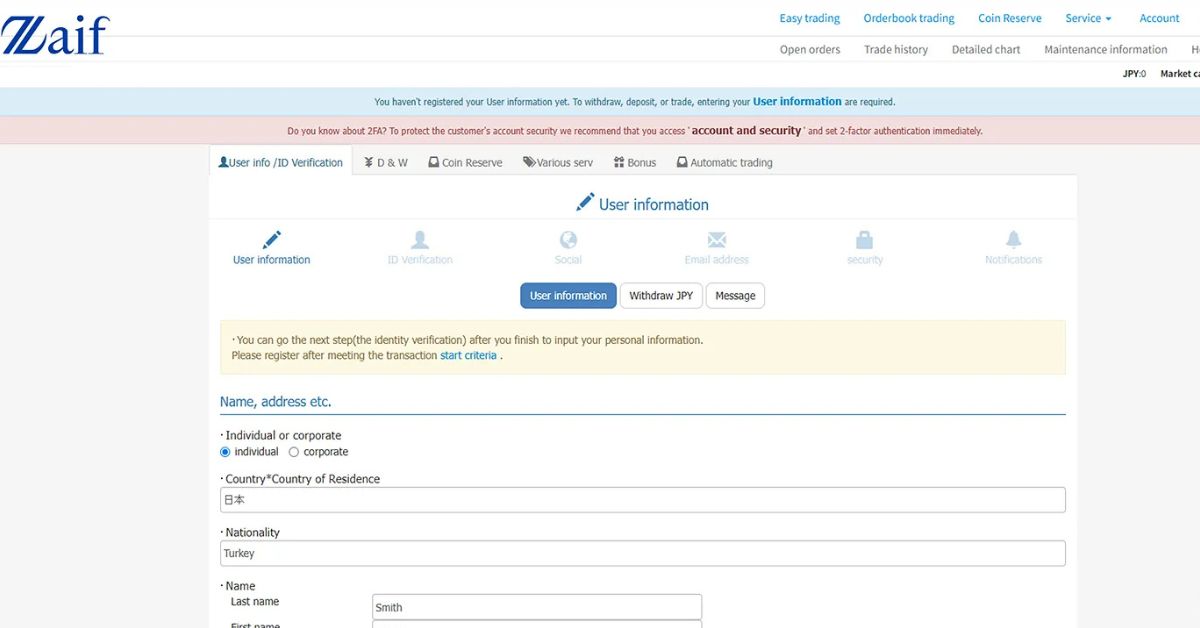
Now, you need to provide personal details such as your full name, address, occupation, income range, and financial status. You should also upload a government‑issued ID and possibly proof of address. This step can feel intrusive, but it’s mandatory under Japanese law. Also, if you want to trade without ID verification, you can also check out our guide on the best no-KYC crypto exchanges.
Step 3: Fund your account
Next, you need to add funds to your account. You can choose a deposit method: bank transfer, convenience store payment, Pay‑easy deposit, Zaif Card, or cryptocurrency transfer.
Step 4: Start Crypto Trading
Finally, as a beginner, you can use “Easy Trading” for instant buys, and experienced users can switch to “Orderbook Trading” to set limit orders or open margin positions. You can also subscribe to “Coin Reserve” for recurring purchases or configure automated trading strategies. Now, place your orders, monitor your positions, and withdraw profits or store coins in a personal wallet.

Zaif Review: Customer Support and User Experience
Zaif provides customer support primarily through an online ticket system and an extensive help center. They do not offer phone support, and the response time is typically between 24 and 72 hours. Zaif does not offer 24/7 live chat or multilingual support. This absence can be frustrating when urgent issues arise.
Honestly, the user experience is “just okay”. The website looks like it belongs in 2015, and navigating between different sections can be a bit confusing if you are used to the polished apps of Bitget or Binance.
Final Verdict: Is Zaif Safe and Legit to Trade Crypto?
To sum up our Zaif exchange review, it is a regulated Japanese exchange with a long history, proper licensing, and improved security protocols. It stores over 90% of client assets in cold wallets, requires two‑factor authentication, and undergoes regular audits. You can trust the platform to execute basic trades and to honour withdrawals.
Now, that said, “safe” does not equal “best.” Zaif’s limited coin selection, high deposit and withdrawal fees, modest liquidity, and intrusive KYC make it less appealing for most crypto traders, especially those outside Japan. Hence, if you are outside Japan, you should seriously consider using international cryptocurrency exchanges such as Binance, MEXC, or Bitget.
Go global with Binance. Join now and unlock exclusive rewards!
