![Best Hyperliquid Referral Code in 2026: [HYPERLIQUIDREVIEW]](https://mtrushmorecrypto.com/wp-content/uploads/2026/02/hyperliquid-referral-code-75x75.jpg)





The Pre-Crash Environment:
![Best Hyperliquid Referral Code in 2026: [HYPERLIQUIDREVIEW]](https://mtrushmorecrypto.com/wp-content/uploads/2026/02/hyperliquid-referral-code-120x86.jpg)
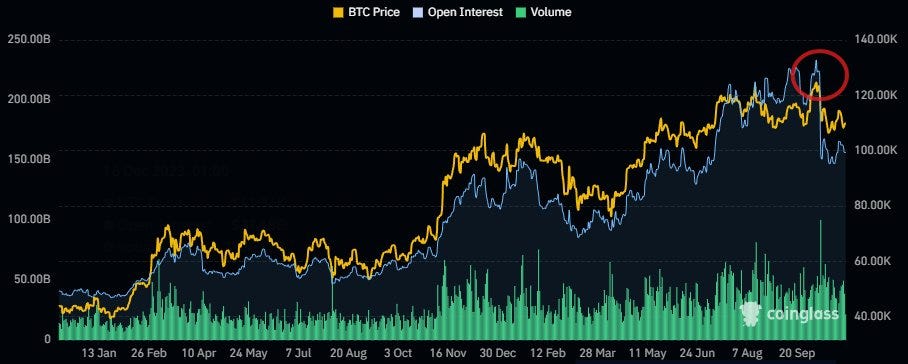
Leading into October 10, Bitcoin was aggressively testing new all-time highs near the $125,000 level. Market sentiment had shifted from simply bullish to euphoric, blinding participants to mounting structural risks. Traders were significantly overleveraged, piling into long positions with little regard for downside protection.
This pushed aggregate open interest to record levels, creating a massive liquidity bubble that was waiting for a single catalyst to burst.
The Catalysts
1. Macro-economic: The China Trade War
Tensions between America and China were already high before October 10, following Beijing’s sudden implementation of export controls on rare earth minerals earlier that week.
At 11:17 AM ET, Trump posted on Truth Social that he would impose a 100% tariff on all Chinese goods starting November 1, 2025. The move was a total rupture. Trump publicly dismissed the need for his upcoming summit with President Xi, stating there was no reason to meet.
The market reaction was violent: the S&P 500 plunged over 2%, its worst single-day drop since April, as investors dumped tech stocks and fled to the safety of gold and Treasuries. This liquidity shock drained risk appetite globally, pulling the rug out from under the overleveraged crypto market.

While Trump often does not follow through with his threats (the famous “Trump always chickens out trade”), major investors still have to price in and hedge against the risk that he will execute his plans.
2. Micro-economic: The MSCI Exclusion Threat
On October 10, 2025, the catalyst arrived in the form of a formal paper from MSCI: the “Consultation on Digital Asset Treasury Companies.”
This document proposed a lethal new rule: exclude any company from the MSCI Global Investable Market Indexes if its digital asset holdings represent 50% or more of their total assets. MSCI’s justification was blunt, arguing that these companies “exhibit characteristics similar to investment funds,” making them ineligible for standard equity indices.
Why this triggered the sell-off: Whales and institutions identified the threat immediately. MicroStrategy (MSTR) and similar Bitcoin Treasury companies rely heavily on the passive bid, the billions of dollars from pension funds and ETFs that blindly buy stocks included in major indices. If MSTR is expelled, that structural buying pressure evaporates.
However, the panic extended beyond just MSTR shareholders. The entire market relies on the MicroStrategy Flywheel:
- MSTR trades at a premium to its holdings.
- It issues shares to raise cash.
- It buys more Bitcoin.
This constant buying pressure supports the Bitcoin price. The index exclusion threatens to collapse the premium that makes this strategy possible. If the premium vanishes, the infinite bid stops.
A note from JPMorgan analysts warned that MicroStrategy could shed $2.8 billion if the MSCI moves ahead. Roughly $9 billion of its estimated $56 billion market value sits in passive funds, specifically those tracking the Nasdaq 100, MSCI USA, and MSCI World indices.
The Danger Zone (Timeline):
- Current Status: Open consultation window (Closes Dec 31, 2025).
- Final Decision: January 15, 2026.
- Implementation: February 2026 Index Review.
The Liquidation Cascade
The Binance USDe oracle glitch
As panic selling intensified following the Trump announcement, a critical failure occurred in Binance’s risk engine.
At 21:36 UTC, Binance’s internal pricing oracle, the system that determines the value of a user’s collateral, began to report the price of USDe based solely on its own internal spot market rather than the industry standard: a global aggregate of all spot markets.
Simultaneously, algorithmic market makers, sensing the extreme volatility, pulled their bids from the order book. Mike Novogratz, CEO of Galaxy Digital, later noted that “30% of market makers” were effectively wiped out or withdrew from the market during this sequence.
With these market makers gone and panic sellers hitting market orders, USDe found itself in a liquidity vacuum on Binance, crashing to $0.65.
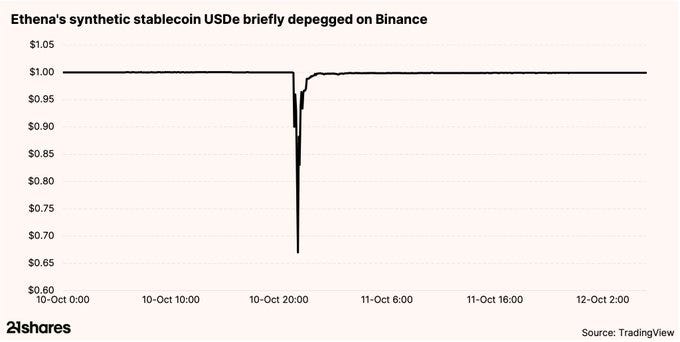
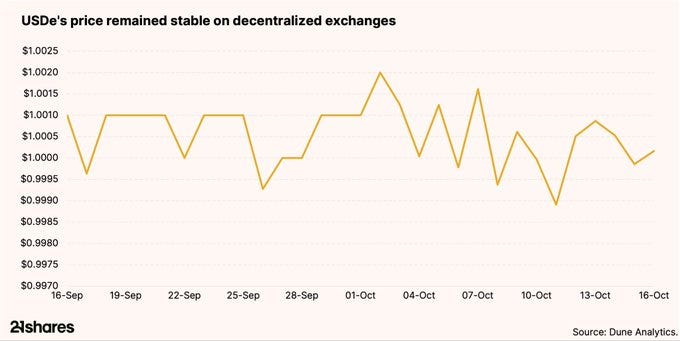
Crucially, this was a localized failure. On other exchanges like Bybit and in DeFi pools, USDe continued to trade around $1.00. To be clear: there was no wrongdoing by Ethena’s mint/redeem function, this was purely an internal pricing error on Binance.
USDe was not the only asset affected by this oracle glitch on Binance. BNSOL (Binance Staked Solana) and wBETH (Wrapped Beacon ETH) also faced major disconnects from their underlying assets. With wBETH trading at an 80% discount to ETH and BNSOL falling to $34.90.
A Critical Observation: Did Binance know about this vulnerability? Yes. Eight days prior to the crash, Binance announced a critical update to its oracle system scheduled for mid October. The goal was to change how collateral values for USDe, wBETH, and BNSOL were calculated, moving from internal spot pricing to external redemption values. This announcement inadvertently placed a target on the exchange’s back, signaling to sophisticated arbitragers exactly how long the “internal spot price” loophole would remain open.
The Negative Feedback Loop
Traders who had deposited USDe on Binance for their trades as collateral saw the value of that collateral drop by 35% instantly. This pushed thousands of leveraged positions below their maintenance requirements, automatically liquidating them.
This forced selling, combined with major market makers de-risking and withdrawing, caused the price of all crypto assets to drop steeply. This, in turn, liquidated even more positions, creating a self-reinforcing crash.

The Final Straw: Automatic Deleveraging (ADL)
As explained before, the flash crash in reserve assets started a cascade of liquidations. This was not only a problem for retail traders but also for the exchanges themselves. Prices were dropping so fast that liquidation engines could not close bankrupt positions fast enough.
This is where Automatic Deleveraging (ADL) comes in. Considered an exchange’s “nuclear option,” ADL occurs when a losing trader goes bankrupt and the market is moving so violently that their position cannot be sold without creating bad debt. To prevent the platform itself from becoming insolvent, the exchange forcibly closes the position of a profitable trader to absorb that loss.
- Scenario A (Normal): The Liquidation Engine sells the position better than the bankruptcy price. The exchange adds the surplus to an Insurance Fund.
- Scenario B (Bad): The market crashes so fast that the position can only be sold at a price worse than bankruptcy. The exchange uses the Insurance Fund to cover the difference.
- Scenario C (ADL Trigger): The Insurance Fund is empty or the loss is too massive. The exchange cannot pay for the loss. To prevent the platform itself from going bankrupt, it triggers ADL.
Who does ADL Target first? Traders with high leverage and high unrealized profits are at the top of the list. They are considered ‘risky’ winners and are the first to be auto-deleveraged.
The formula:

The Altcoin Massacre
While Bitcoin and Ethereum suffered significant drawdowns (approximately 10–13%), the altcoin market faced total collapse. The liquidity for these assets is naturally thinner, but on October 10th, it evaporated due to the withdrawal of market makers. ATOM on Cosmos faced a wick to $0.001, essentially selling 2,531 ATOM for free for a split second. Uniswap experienced a 26.92% decline with a massive intraday drawdown wick of 70.10%. Aave saw a maximum drawdown of 69.48%.

The Academic Verdict: Quantifying the Inefficiency
In December 2025, a research paper titled “Autodeleveraging: Impossibilities and Optimization” by Tarun Chitra provided a mathematical post-mortem of the crash. The study analysed the exact ADL mechanisms used during the event and found startling inefficiencies.
The paper demonstrated that Hyperliquid overutilized ADL by approximately 8x relative to an optimal policy. This inefficiency alone imposed roughly $630 million of unnecessary losses on winning traders who should have been safe.
More damningly, the research suggested that Binance, which uses a less transparent, legacy ADL engine, overutilized the mechanism far more than Hyperliquid. This academic analysis supports the theory that billions of dollars in trader equity were wiped out not by market movements, but by inefficient exchange safety protocols engaging in a panic mode response.
The Timeline

How did different blockchains handle the spike in volume?
Despite massive volatility, the Solana network held up remarkably well. Fireblocks reported that Solana validators processed 100,000 TPS of inbound traffic (6X their average peak) and maintained 400ms block times with zero downtime.
Ethereum, on the other hand, struggled under the extreme load. On-chain gas fees surged to approximately 450 Gwei, dozens of times higher than normal. This meant that a single swap or transfer could cost between $400 and $500 at the peak of congestion.
While the protocol itself did not fail, the resulting mempool congestion priced out many participants. This network latency exacerbated losses in decentralized finance (DeFi). Users on lending platforms like MakerDAO found themselves unable to pay down debt or add collateral in time, leading to onchain liquidations that might have been avoidable if the network had been accessible and affordable.
Conclusion: Was this the largest liquidation event in crypto?
Yes. The data confirms that October 10, 2025, was the single most devastating day in crypto leverage history.
Most sources will tell you that the amount was around $19.3 billion liquidated from the market. We believe this was a lot more; Binance, the largest crypto exchange, reported only $1.4 billion liquidated in 24 hours. This doesn’t make sense since smaller exchanges had far larger amounts of liquidations.

Does this mean Binance had less trouble with ADL and mass liquidations? No, absolutely not. Binance only reports 1 liquidation per second via their API; this causes a vast number of liquidations to be left unseen. Therefore, the actual number of total liquidations on October 10 likely lies closer to $30 — $40 billion
What happened on October 10th shows us exactly how hyper financialized and interconnected the crypto market really is. One exchange having oracle issues will likely start a downward spiral of connected issues. It shows how connected DeFi still is to CEXes and how one vulnerability can ‘bleed over’. While Brian Armstrong (Coinbase CEO) argues for circuit breakers to prevent these spirals, others see this as a betrayal of the core ethos of this industry. The debate isn’t just about safety, it is a battle for the very soul of the industry. As Erik Voorhees (ShapeShift Founder) argues, if we trade sovereignty for failsafes, we risk rebuilding the very walled gardens we set out to dismantle.
What caused the largest liquidation event in crypto of all time? was originally published in The Capital on Medium, where people are continuing the conversation by highlighting and responding to this story.
![Best Hyperliquid Referral Code in 2026: [HYPERLIQUIDREVIEW]](https://mtrushmorecrypto.com/wp-content/uploads/2026/02/hyperliquid-referral-code-350x250.jpg)